Central Park West, The Climate, and the Crowd

ClimateMarchSept2014I didn’t have one of my nature walks Sunday, at least not the kind with solitude and a soundtrack of late summer birds and crickets amid a subdued Connecticut neighborhood. I did walk, very slowly, from 86th and Central Park West down to 34th and 11th,  and I had lots of company. Almost 400,000!

I prefer my walks alone, but Tom and Gavin, and another 399,097 or so others came along to say something about climate change. I’ve been reading about nature and the earth long enough to know that this is not just a passing trendy belief. The climate really is changing, and not in favor of living things. There’s no longer a credible debate that says otherwise, and I was happy to see a lot of scientists, complete with lab coats, in what one recently interviewed joiner, the highly credentialed Peter deMenocal (Professor, Department Earth and Environmental Sciences, Columbia University), proudly called “a nerd parade”.

People had lots of solutions and motives on their signs—they marched for the birds, for the arctic, for their grandchildren, for simple living, for socialism, for radical revolution, for conservation organizations, with their churches—a huge variety from confrontational (although as far as I know there was no violence) to peaceful, from tree huggers to pragmatists. But the group was united in that they recognize a genuine problem and are trying to raise awareness and push for solutions. And there are some solutions–but we are at a point now where governments must act to effect real change, along with each individual doing his or her part. Here’s a good summary of broad solutions by National Geographic. And here’s a link about actions to consider at your own individual level. The march preceded the UN Climate Change Summit, calling for urgent action, globally, in response to the problem.

CLimateMarchBUGThe first arm of the People’s Climate Change March ran along Central Park West, and I liked looking up at the grassy hills, people climbing streetside boulders, and the ubiquitous pigeons, who seemed to be watching the noisy human display with great interest. A bug hitched a ride on Gavin’s sign for quite a few blocks, and I imagined him shouting “we are here!” (as in the iconic Horton Hears a Who), a microcosm of what the marchers were doing! We also enjoyed occasional trees and gardens perched atop some of the tony parkside buildings. Even in crowded Manhattan, nature has a way of inserting itself.

Pretty good stick imposter: my first sighting besides the indoor creatures at Audubon Glastonbury

Pretty good stick imposter: my first sighting outside of the indoor creatures at Audubon Glastonbury

Back in CT a friend at work pointed out a stick bug hanging out by our office entrance. I’ve never seen one in “the wild” before—surely because they blend in so seamlessly with the plant life! Today a coworker’s kids reported to me that they saw a parakeet flying around outside, and in return I showed them my pictures of the stick bug. 2014-09-22 13.36.51

Speaking of kids, they really are the future,  although I risk sounding like an 80s pop song when I say that. But see for yourself: the winners of this video contest got to go to the UN Summit.

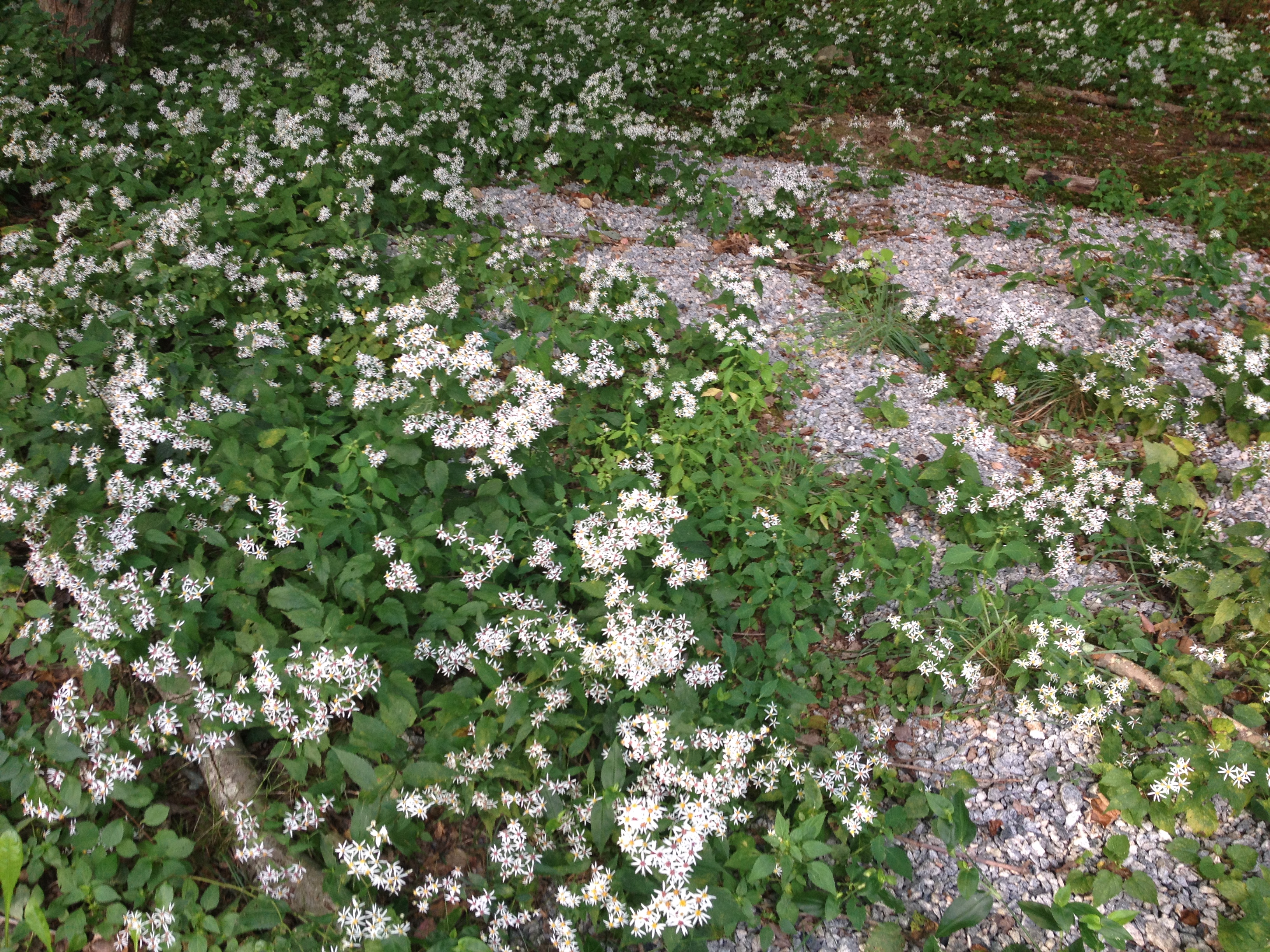
Aster Place Comes to CT

Astor Place in New York (Cooper Union building) by David Shankbone

Astor Place in New York (Cooper Union building)
by David Shankbone

I went to school in Manhattan for a while, and Astor Place meant a street in Greenwich Village, named after the incredibly wealthy John Jacob Astor.


Aster Place in Deep River

Aster Place in Deep River

When I pulled up my driveway earlier this week, I nearly rubbed my eyes to check my vision. Beyond the comforter and sheets bobbing on the clothesline, and further back, beyond the French drain to the mossy, moist part of the yard, was a sea of white stars. Uncountable asters had grown up, seemingly overnight. We’d never planted them; they just are; a visitor that comes every year as autumn approaches.

Toward the end of last autumn I picked a brownish, aged aster and placed it in a cobalt blue vase. My husband tossed it, thinking it was a bud that had stagnated from neglect. But I saved it because, even well past its prime, it had a modest, stalky beauty, well preserved. It was stalwart after summer ebbed, and I had to give it credit for its staying power.

The common name for the aster flower, which can bloom in white, blue, or purple, is the Michaelmas daisy, so named because it coincides with the feast of St Michael the archangel, according to Herbs Treat and Taste. The site also tells me that Virgil, some years before the start of AD (or Common Era), wrote about the flower, alluding to its use on holy shrines. I treasure the timelessness of these words nearly as much as I do gazing down out our bumper crop of stars:

There is a useful flower
Growing in the meadows, which the country folk
Call star-wort, not a blossom hard to find,
For its large cluster lifts itself in air.
Out of one root; its central orb is gold
But it wears petals in a numerous ring
Of glossy purplish blue; ’tis often laid
In twisted garlands at some holy shrine.
Bitter its taste; the shepherds gather it
In valley-pastures where the winding streams
Of Mella flow. The roots of this, steeped well,
In hot, high-flavored wine, thou may’st set down
At the hive door in baskets heaping full.

Woody Guthrie, Robert Frost, and The Mountain

cattleAt long last, we managed to get ourselves down to southern Virginia this summer, a trip vastly overdue and a time to reconnect with family. There are other chapters to be written about ties that bind and family history, but this one is about the land.

When we woke, whether we looked out the front or the back window, there were cattle, and, once, a young buck grazing among them, pretending at being a steer. Aunt Norma, dealing with medical issues and unable to take the journey herself, emphasized the importance of going up the mountain, and cousin Mike took the men on the long drive up. Cattle were fed; pictures were taken. I remember going up there as a child and picking wild strawberries, and turning strong lights on at night so we could see the deer. Mike’s father, and the grandfather we share, raised cattle, too. I’m told my father cowboyed out west, summers, and it helped pay for school.

I didn’t go up the mountain, but I sat overlooking the hills in the mornings, and one day walked up the dirt road—more cattle to visit but also the hum of crickets and birds, tangles of wildflowers, and unfolding curves that beckoned me. Trees waved in the gentle breeze and I thought of my father, who also loved this land. I visited the cemetery, where he and many of my other relatives’ tombstones nestle in the green grass, the markers weathered and hosting lichen and moss, not far from the mountain.

Woody Guthrie was right—this land is our land . But so was Robert Frost in The Gift Outright —“the land was ours before we were the land’s.” His poem, an inaugural one for John F. Kennedy, talks of nations and war, and my people were part of that story, too. But this part makes me think of the mountain, and how it owns us all now:

Something we were withholding made us weak
Until we found out that it was ourselves
We were withholding from our land of living,
And forthwith found salvation in surrender.
Such as we were we gave ourselves outright

I’m told there are some cousins, most of whom I’ve never met, who aren’t especially attached to our family’s mountain. But I am so glad for those who have given themselves to it, seen the grace that it holds; longed for, sought, and found wordless connection there. We are the land’s as much as the land is ours. And the connection we feel comes with responsibility; if you spend enough time in nature this realization becomes unavoidable. Teddy Roosevelt, another lover of mountains, said it well:

The Mountain (Hampton)Here is your country. Cherish these natural wonders, cherish the natural resources, cherish the history and romance as a sacred heritage, for your children and your children’s children. Do not let selfish men or greedy interests skin your country of its beauty, its riches or its romance.

And Gary Snyder has summed up the way that many feel; the way that I felt in Virginia although I was hours away from my house and usual environs:

Nature is not a place to visit. It is home.