Honey Guides, Bentonite, and Ayer’s Rock

My wanderlust is usually rather micro. I am often quite content with the many things to see and hear and learn on my local walks, in the many routes I can take without even without leaving Deep River.

Portage coverBut this week has got me thinking about nature that’s farther flung. I’ve finished reading Portage, by Sue Leaf, an account of the writer’s canoe trips north and west of here, including the Boundary Waters Canoe Area Wilderness, parts of Canada, Wisconsin, etc. (The only canoeing book I liked more was Yukon Wild!). The author devotes nearly two pages to bentonite clay, a substance that arises from ancient volcanic ash along rivers like the Little Missouri.
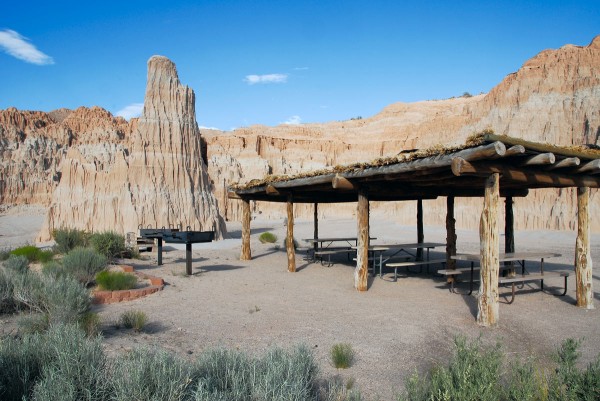
Cathedral Gorge is located in a long, narrow valley where erosion has carved dramatic and unique patterns in the soft bentonite clay. IPhoto/caption from Nevada State Parks site.

Cathedral Gorge is located in a long, narrow valley where erosion has carved dramatic and unique patterns in the soft bentonite clay. Photo/caption from Nevada State Parks site.

Of course, having to slog through the wet version of the stuff doesn’t sound like any fun; there are tales of clay stranding hikers for days or holding horses in place, but it’s cool to think about parts of the country that have great swaths of stuff I haven’t ever seen. This same nuisance-y stuff is treasured by herbalists, used in facial masks, toothpaste, etc.

Reading about bentonite also unleashed a dormant memory of a grade-school class trip to Caumsett State Historic Park Preserve, a treasure of Long Island’s North Shore. I’m not sure if I’ve created an exaggerated memory, but I seem to remember standing on a large “boulder” (for lack of a better term) of an unfamiliar substance, and our tour guide, perhaps a park ranger, telling me that it was sea clay. I was quite taken with its texture and the fact that it had appeared along the shore—I had spent so much time on South Shore beaches but had never seen this stuff.

Gavin’s been scooping up clay for years from the seasonal “stream” (basically a tract for runoff from the higher-grade forest spring thaw) that runs along the boundary of our property. This Stay Curious blog (great name for a blog, don’t you think!) has an account of the author’s discovery of little clay lumps (lots of them!)  along Bald Head Island beach in North Carolina. It got me wondering if my potter neighbor would be able to mold a work of art with them.
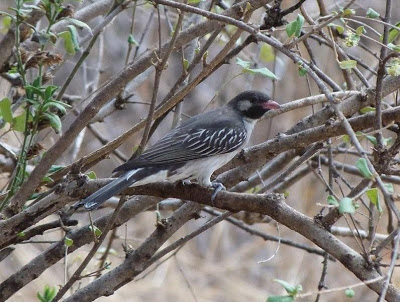
Greater Honeyguide photo reprinted with permission from Safari blog

Greater Honeyguide photo reprinted with permission from Safari blog

From my clay exploration route I hightailed it (virtually) to East Africa. Hadza: The Last of the First  is worth watching. It’s a well-executed documentary about the region’s last remaining true hunter-gatherers, whose way of life is threatened by encroaching civilization and government interests. There’s more than a blog’s worth to write about in terms of the tribe (see the movie!!), but from a naturalist perspective I was quite fascinated by the Honeyguide bird, which actually works with humans to lead them to hive sites. The humans extract the honey and give some of the honeycomb to the bird. This blog  does a great job describing how the interspecies communication and collaboration works.

My third jaunt in this salvo of armchair trips was courtesy of Bill Bryson. Gavin and I are both reading In a Sunburned Country for the second time (wow that guy can really write!). With the knowledge that Bryson is so very well-traveled, I took it quite seriously when he encouraged me to somehow find my way to remote Australia so I can see Ayer’s Rock in person. I could see that even Bryson struggled a bit to encapsulate exactly why this 1,150-foot high, mile-and-a-half long, five-and-a-half mile around “rock” left him astounded, declaring it was worth a 600-mile round trip.

Photo from Parks Australia on Pinterest

Photo from Parks Australia on Pinterest

The rock is technically a bornhardt, per the author “a hunk of weather-resistant rock left standing when all else around it has worn away.” After nearly 3 pages of noting that pictures don’t nearly do it justice, and that being there left him nearly inarticulate but somehow feeling that the rock was primordially, or even supernaturally, vastly meaningful, connecting with it in a nearly indescribable way, he was forced to wrap it up by saying, in uncharacteristically monosyllabic fashion for such a wordy guy: “Go there, man.”

From my chair, out West and on to East Africa and Australia. All of this almost topped the local adventures to follow here at home: cormorants through my binoculars, hungry birds encircling the feeder, long walks in the surprisingly mild late November air. Thankful for adventures outdoors, both far and near,  vicarious and in the flesh.
Join the Club (Moss)!

One of the best things about being out in nature is the absolutely limitless supply of opportunities to learn. On par with that plus are the many reasons for hope and delight to be found in places as seemingly humble as the forest floor.

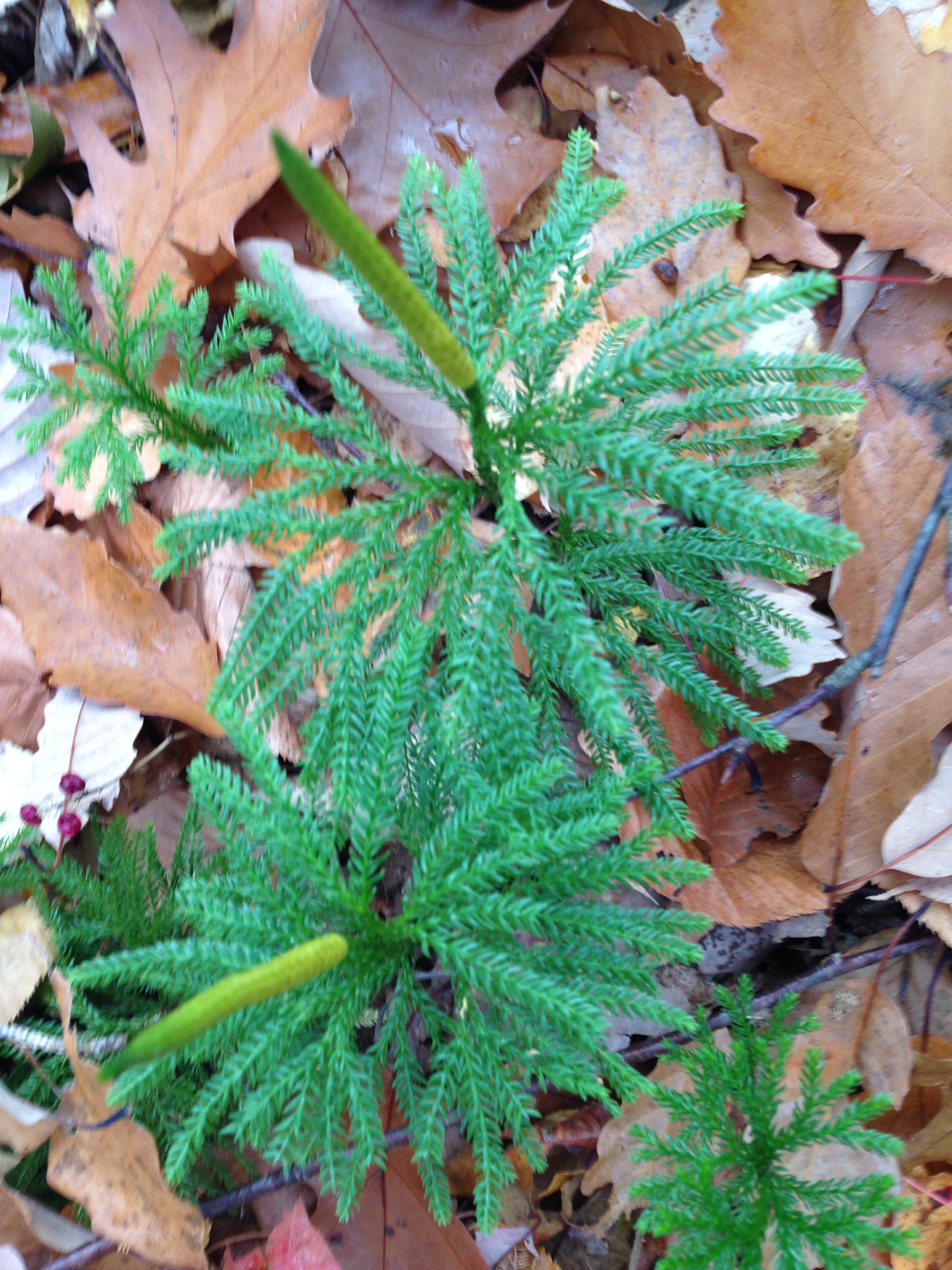
My latest study—and also hopeful venture—is club moss. This link leads to the inaturalist page for Connecticut club moss sightings. I am particularly enamored of running pine moss, which really does look to me like a little figure that’s about to dash off a la the Gingerbread Man of childhood story books (it’s pictured in above link)! But most often, in the Cockaponset State Forest behind our house, I see princess pine:

2015-11-05 07.54.11

According to inaturalist its spores used to be used as flash powder (in early photography or magic tricks ). I know if I tell Gavin he’ll want to try that out pronto, and preferably with bushels of spores. Come to think of it, some adults I know would be right on that, too. (Can’t vouch for how to do this, or for safety. Also, some states list the plant as endangered, likely a result of earlier enthused harvesting.)

This Massachusetts land trust’s site has a nice write-up about the princess pine. What I like best about this diminutive species, which is not a pine at all, is its evergreen-ness. It comforts me when I think ahead to the depths of winter. It is also such a pretty and precise-looking plant.

Before I read The Beginning Naturalist by Gale Lawrence, I’d assumed that the princess pine and other similar club mosses were baby evergreen trees. But they are already fully grown, and they are not in the conifer family. Confusingly, the club mosses are not mosses, either. They are closer to ferns. The “club” refers to the club or spike that shoots right up from the plant—it is coated with a fine layer of spores. The growth from spore to mature plant takes a full 17 years, but some plants can also grow by sprouting along the same stem.

Gale Lawrence’s chapter on these plants amused me, because she refers to the “attacks of the Christmas decorators.” Determined crafters let loose in the woods can pull up whole long underground stems of club mosses for weaving into wreaths, wiping out that impressive life cycle with one good yank. Even without the greenery of Christmas in mind, it is a bit tempting to imagine taking one of these miniature (non) trees home. But the happy-seeming plant has worked too hard to become a pet. Best to visit it in its “home in the loam,” beside its mushroom, acorn, and looming tree neighbors.

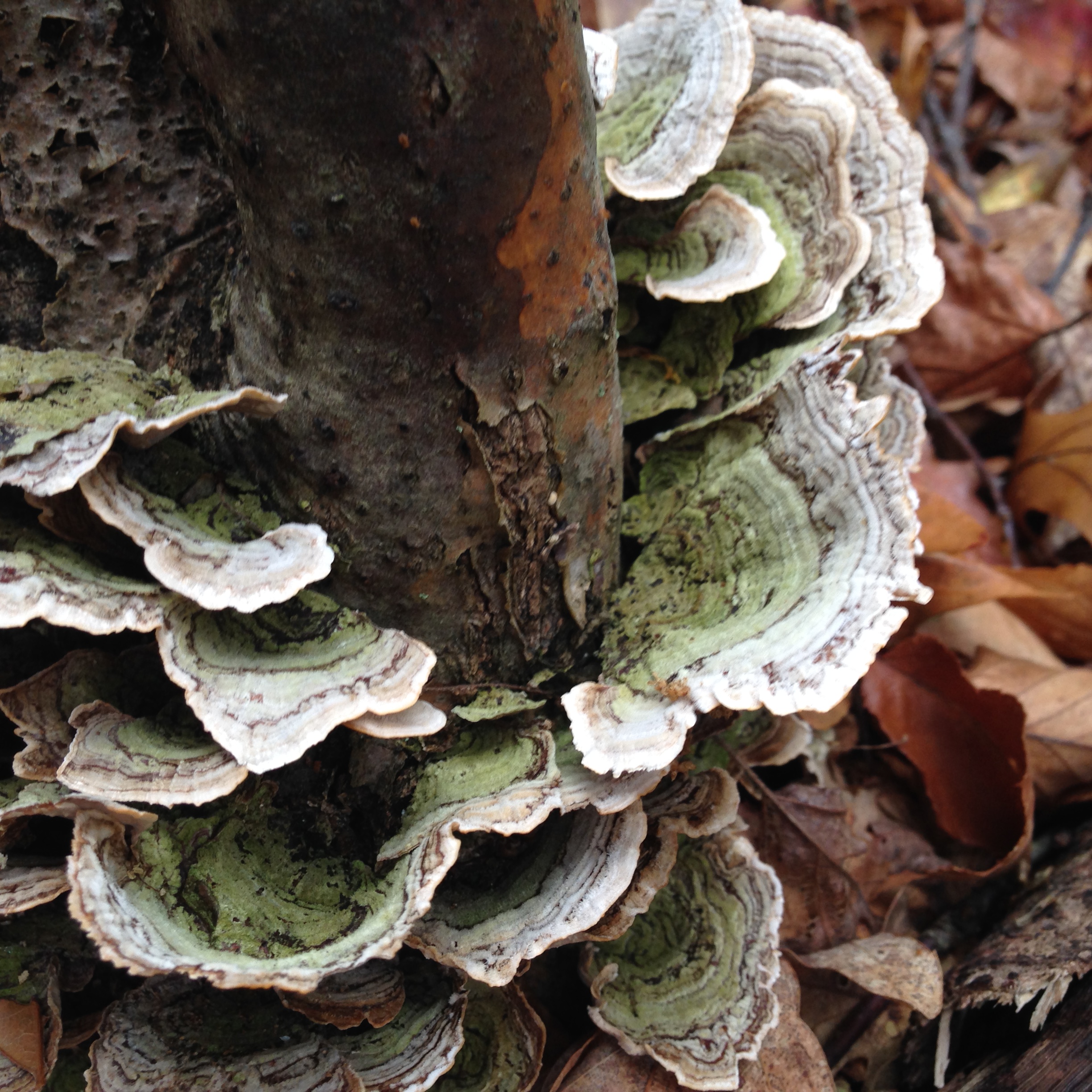
BONUS photo for those who read to the end! 😉 : the decorative lichens (or could they be mushrooms??) adorning a stump in our yard! This is just a bit blurry, but I can’t be the only one who thinks these are simply gorgeous.

2015-11-10 07.25.39


Indian Summer: Just 9 Days

Web photo (mine)I’ve tossed the term around since first hearing it in childhood: Indian Summer, indicating a surprisingly warm period after we’ve already had a cold snap. Well, I got the general idea right. But according to The Old Farmer’s Almanac, Indian Summer must technically fall between November 11 and November 20. So as I write this, we’re almost at this very specific window, although I do wonder if the Almanac people do any adjusting in light of climate change! There are more criteria than just dates, though:

“As well as being warm, the atmosphere during Indian summer is hazy or smoky, there is no wind, the barometer is standing high, and the nights are clear and chilly…The time of occurrence is important: The warm days must follow a spell of cold weather or a good hard frost.”

Why the term “Indian?” The Almanac’s prevailing opinion is that it refers to how the Native Americans could have “one more go” at the early New England settlers when the weather turned warm again. I prefer the story about the early Algonquians’ belief that the warm weather was sent by their southwestern god, Cautantowwit.

lichenWhether or not it’s fallen into the prescribed time period, creatures great and small here in Connecticut have been enjoying this reprieve from the autumn chill. Just a couple of weeks ago I awoke to find our porch begonias dead from the overnight frost, their rosy blossoms “bleeding” onto our yellow railing. But then it turned positively balmy again. Over the last week or so I’ve seen bees lingering over the asters. I photographed a jewel of a spider’s Web on our front hedge. And I’ve walked through the Cockaponset (conveniently located behind my home), admiring its generous décor of mushrooms and lichen. These moments, usually grabbed after Gavin gets on the bus and before I have to drive to work, are deeply appreciated as the days get shorter and the trees shout out their gold and orange songs.

One day, I was in a cranky mood and was positively stopped in my tracks by the gleaming gold in the afternoon sunlight outside. I really felt that I was being shouted at, reprimanded by beauty: how bad can it be when I’ve got this display right outside my door?

gold leaves

Robert Frost said it best: nothing gold can stay. But isn’t that why we treasure it so?:
Nature’s first green is gold,
Her hardest hue to hold.
Her early leaf’s a flower;
But only so an hour.
Then leaf subsides to leaf.
So Eden sank to grief,
So dawn goes down to day.
Nothing gold can stay.