Frog Pond

Yesterday, I looked down into a transient ecosystem that thrived in a large bucket at my feet. I took my son Gavin and a friend frogging at our local pond. No matter that it’s in a cemetery—the modest body of water is quivering with life, and our bucket hosted at least 6 frogs, probably twice that many tadpoles, a host of minnows, and a large beetle that swam circular laps with the vigor of an Olympiad. (Or was it a Giant Water Bug, often mistaken for a beetle?).

The boys conferred about the gauge of the nets and the length of the sticks that they were attached to, and what they might garner with each plunge into the muddy depths. I wished I had a stop-action camera to get real-time shots of all the incredible skyward frog escapes. The most impressive creatures of the day were the two thick, ropy Northern Water Snakes that the boys reported (they actually called them rat snakes, but after some research I think this was a misidentification). We released the whole, squirming bucket in the end, washing the sludgy mud off shins and hands with baby wipes before heading back to the commercial world of pizza, chips, Slushies, and candy.

I believe that every town should have at least one well-frequented frog pond, and Googling around for other fine, civic frog pond examples I ran across Save the Frogs! Our frog populations are dwindling because of a variety of factors, among them climate change, invasive species, and habitat loss, and this nonprofit does a lot of education, also encouraging citizen scientists like you and me to build our own frog ponds. So get digging!

Sometimes it makes me sad when I am out and about walking, or taking another turn around the pond, and I don’t see many other interested individuals or families outdoors—I am fervent in my hopes and prayers that we, as a society, reunite with the outdoors and learn from the connections that we can make there. Science, philosophy, spirituality, medicine, relationships–it’s all there for us to learn! I am borrowing a quote by Chief Seattle (1854) that Save the Frogs showcases on their site, plainly put but it rings so true, especially at the lively height of summer:

 And what is there to life if a man cannot hear the lonely cry of a whippoorwill or the arguments of the frogs around a pond at night?
Dirt—I mean Soil—Rocks!

I picked up an older nature book today. I was twelve when it was published, and that summer in 1979 I wandered hills and meadows not far from where Gale Lawrence published The Beginning Naturalist in Shelburne, Vermont.

At first I was a little antsy about how very basic the book was, with chapters like “Winter Trees” and “Robins.” It’s not that I don’t appreciate both heartily, but this book falls more into the “informational” than the “lyrical” category. I am impressed by the dazzle of both words and nature and this reads more like a series of little talks a trail guide might present; not too many word arabesques and pirouettes!

But when I flipped through the pages, it didn’t take long to realize that I needed just such a basic guide. I was particularly struck by how little I knew about dirt! Okay, make that soil (turns out they mean different things: dirt is basically soil that’s left its original ecological home).

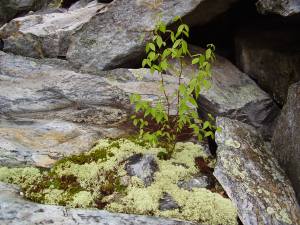
Probably well before that 1979 copyright, I must have learned about the origins of soil in school. But I honestly haven’t thought much about it since—how soil is basically weathered and eroded rock, mixed in with what plants and animals contribute. Lots of things work on the rock, which is so misunderstood as an immutable object—it’s changed by wind and rain, plants, and the acid secreted by lichens (which are actually algae and fungi working together). When lichens die, they disintegrate and mix with tiny rock fragments, and the resulting little patch of dust nestled in a tiny crack can be the perfect home for a new plant. On and on it goes until there’s more plant than rock.

Trying to watch the process would be eons longer than watching paint dry, but I appreciate that it’s happening in slo mo, with that verdigris color, that patina so many lichens sport a fitting hue for such a worthy vintage endeavor.

John Muir had a way of getting at the interconnectedness that sometimes a good nature book, and often a long walk, can convey. In My First Summer in the Sierra, he wrote:

Everything is flowing — going somewhere, animals and so-called lifeless rocks as well as water. Thus the snow flows fast or slow in grand beauty-making glaciers and avalanches; the air in majestic floods carrying minerals, plant leaves, seeds, spores, with streams of music and fragrance; water streams carrying rocks… While the stars go streaming through space pulsed on and on forever like blood…in Nature’s warm heart.

PS: I’m adding a new link here on the site to Mile…Mile & A Half, a movie about a hike along the John Muir trail. It’s a real cinematic treat for anyone who loves to walk, loves nature, and especially for those who hope to hit a long trail with a serious backpack someday.

The Call of Pick Your Own

We have an orchard within a long walk from our house. We’ve never walked to it, though, because how could we leave there without carting an abundance: bushels of apples, jugs of cider, prizes from the farm stand? Our haul wouldn’t mix well with the busy road and its narrow shoulder, although I still consider the adventure from time to time.

It was at this orchard, only a few years ago, that I first saw a pear tree. I was taken by its golden aura in the early autumn sunlight. Every year they put out a PYO (pick your own) sign when the berries come in, and somehow I never make it there—in fact, I don’t recall ever picking berries from a patch. This year, I am determined to make it to blueberry harvest and emerge, stained purple, happy, and ready for a pie.

I’ve been reading about harvests lately, a venture that goes so well with the spilling proliferation of summer, vines and stems laden with promise.

Anne Porter (who was artist Fairfield Porter’s wife) captures that spilling over in her poem The Pear Tree—here are the last two stanzas:

And every blossom
Is flinging itself open
Wide open

Disclosing every tender filament
Sticky with nectar
Beaded with black pollen.

In Early Spring, ecologist Amy Seidl mixes her scientific knowledge about climate change with her love (and worry) for her Vermont surroundings. Her words about berries make me want to garden ambitiously, perhaps even with an orchard in mind:

 …I walk the acre as if it were a hundred, planning the geometry for my fruit tree grid. I envision apple, pear, and plum, and of course the hardy Reliance peach. And in as many places as possible, berries: currant, gooseberry, blackberry, raspberry, and blueberry. The list of varieties reads like a children’s fairy tale, a version of “Hansel and Gretel” where visitors stumble across an Eden dripping in fruit rather than a cottage dripping in frosting. It is very much a gardener’s fantasy, one founded in the belief that life is abundant and the role of humans is to work with nature to manifest more abundance.

This triggered a memory of my own attempt to capture an orchard on a page, actually a specific, memorable day when Gavin was still quite young and  first learned to love apples:

Orchard Day

Miles of trees, Macoun, McIntosh, Empire
and then the illuminated pears

The perfect gild and form
made him lean from the wagon
grabbing for fruit

At home we leaned down together to core it all,
heard the breaking skin, split and crunch, squirt of juice

How solemnly he sought and sorted the seeds,
big plans to plant our own grove just outside

It was a little cold that day–didn’t know the right depth or soil or way to tend

Should have planted them anyway.

Plugging in at Sunrise

Impression, Sunrise by Claude Monet

Impression, Sunrise by Claude Monet

I noticed that a lobby area at Wesleyan University has charging stations, where students can restore their iPads or phones to full buzz. And yesterday, our teenage guest needed our network login code, our specialized charger cord, our outlet.

I’ve been thinking about another, deeper way to charge. It’s 5AM, and my own smartphone tells me that sunrise is at 5:22. But the birds have been gearing up for dawn over this last hour. When I hear their predawn symphony its reminds me of the angels on the beach in the movie City of Angels–they are watching, waiting for the first burst of light, tuning in to a profound and mysterious message that’s not spelled out in the dialogue (warning: the bare posterior of Dennis Franz at the end of this clip is not quite as profound, but then again this part of the scene makes its own point about immersion in what matters).

It’s a personal anniversary for me—a year and a day since I started my book about what nature has to teach us. I’m not the first—there are big shoes to fill in this department, and come to think of it I’d be happy just to pick up the trail with my much smaller footprint. Take, for example, Diane Ackerman, who does her own “singing” about sunrise in  Dawn Light: Dancing with Cranes and Other Ways to Start the Day. Here she appreciates impressionist Monet as a “sensate”—someone acutely tuned into the gifts of the world:

Monet simply proclaimed, and adored, what we all experience from moment to moment: the wash of sensations that greet us on waking, and which we try, at our cost, to dismiss as wasteful, self-indulgent, unproductive, or by some other term designed to separate us from our true self. The freedom of unbridling that self and losing it in nature is immeasurable. Alive moments can be anytime, anywhere. If I closely watch any natural wonder, really watch it, nonjudgmentally, in the present moment, noting its nuances, how it looks in changing light, or on different days, yet remains recognizably the same, then the world becomes dearer and less trying, and priorities rearrange themselves with an almost audible clicking. 


Can you hear it too—that whisper of a click? Its message to me is to hit “save” and get out into the birdsong.