The Book of Noticing

2016-05-01 08.32.39

Admirable tree in East Haddam

Soon, I want to write about tent caterpillars and robins and nests and the soul’s ease that comes with long walks during lengthening days…But this post is just a short one, because I want to share great news!

I just signed a contract to have The Book of Noticing: Collections and Connections on the Trail published by Homebound Publications. So, this time next year I expect to have the bound book ready for release into the world! There may be Kindle and audio editions, too!

The Book of Noticing is a contemplative narrative on time in nature and the deeper truths that the experience reveals. It takes in the variety and beauty of many adventures in New England, weaves in intriguing facts from the natural world, and often steps back to look at broader subjects like family, a meaningful life, and the future of our planet.

(That being said, I need friends to help me perfect a really good “elevator speech” that can help me encapsulate what this book is about! I have less than a year to learn how to be a good marketer, and any and all tips will be genuinely appreciated).

2016-05-07 08.17.51.jpg

My neighbor on Bridge Street has been mowing around these beauties!

Hodgepodge Lodge, and Considering the Lillies

frogs

Since I can’t share my own hodgepodge of a collection firsthand, this blog is sprinkled with some Deep River wonders. These frogs live at Fountain Hill.

When I spout reminiscences about the Hodgepodge Lodge show to other people my age, I get a lot of blank looks. I guess I should be grateful my mom steered me over to PBS. Because the Lodge was a big influence during my formative years. If you’ve never been initiated here’s a clip from YouTube.

I have fond memories of the kindly woman who starred in the show and her many lessons in the ways of wildlife. Miss Jean was very pragmatic also, and sometimes the wildlife -while clearly appreciated -got eaten. For some reason, the episode I remember most is one about cooking food  (fish, I think) in a Dutch oven buried underground. I perceived the results as nothing less than magical. But most episodes didn’t center on cooking. I remember cocoons, frogs, caterpillars, kids with butterfly nets,  and a meadow. I researched the show and Miss Jean and the actual Lodge just now, and was touched to learn that the original Lodge, built to be a set for the show, was restored and moved to a nature conservancy in Maryland. It also seems that Miss Jean is still an active contributor to the nature scene (and I have just written her an email fan letter, nearly 40 years after the show went off the air!).

Over the last decade or two, I’ve been returning to my Hodgepodge Lodge roots, which harken back to the days when I still wore many hand-me-downs, blissfully unaware of how I looked or why that could ever matter. When I show up at local nature events—at places like Connecticut Audubon Society or The Stewart B McKinney National Wildlife Refuge or the Flanders Nature Center, I am garbed in attire that might be described as anti-fashion. Practical, comfortable shoes; layered clothes that can get dirty; something to cover my head should it rain; back pack stuffed  with more practical items. More and more often, binoculars dangle from my neck. I am nature nerd central. (Speaking of nature nerds, a fellow naturalist has a good blog named just that: Nature Nerd).

Aside for word nerd readers: the term hodgepodge “comes from hogpoch, alteration of hotchpotch (late 14c.) ‘a kind of stew,’ especially ‘one made with goose, herbs, spices, wine, and other ingredients’,” according to the Online Etymology Dictionary.

When I look around at my fellow nature lovers, they are – almost without exception – fashion challenged as well. But the appeal for me is in their alert eyes and interested expressions. They are asking questions, or peering into the water, or trying to recall something they read. Sometimes, an expression of amazement surfaces, with the sighting of a creature or a prized new fact learned. These are my adopted people.

Recently, I was part of a small gathering of Edwin Way Teale fans. We met at Trail Wood, the place where I had my writing residency this past summer, and shared our favorite passages from his work. We sat in a circle surrounded by inquisitive (but not biting) may flies, reading aloud and pausing to comment or look up at a bird or wonder aloud if we might spot the various species Teale recorded on the surrounding land. It was nice to think of Edwin and his wife Nellie having their many adventures on the nearby trails.

The information shed on the Trail Wood property has its own Hodgepodge Lodge type of accoutrements that come and go over time, like a wasp’s next or feathers or the white board where visitors can note the creatures they spotted that day. A side room houses some taxidermy, and curious visitors can also thumb through the musty guidebooks and other nature-themed reads shelved there.(See this CT Woodlands issue for mine and a fellow nature writer’s pieces on Teale and Trail Wood).

Teale cabin quote.jpg

This sign is inside the Teale cabin at Trail Wood. The glare obscures the attribution, but I believe it is from an old tombstone in England.


I relish collections like this; the more eclectic the better. In an older entry I wrote about one enviable cache kept by an archaeologist and cartographer. The original name for my book – Cabinet of Curiosity (recently submitted to an interested publisher, now with a different title!) – reflected the happy collecting of talismans from nature. And a great read from Vermont Quarterly that my sister put aside for me, about Bernd Heinrich, included snippets about what he’s accumulated in his rustic Maine cabin. His laptop sits amid a set of watercolors, field notes, field guides, etc, with hawk feathers and binoculars nearby and a whole tree trunk holding up the ceiling. I love this part of the article:

On the way out the door, I stop to photograph three items on the window ledge: a pair of desiccated spiders pinned to a block of foam; a pile of animal poop which includes a bird’s claw; and an embossed circular medal. “Those barn spiders had just laid their egg clutches,” he tells me later, and the scat was probably deposited by a coyote who had eaten a grouse. “I saved it to quiz the winter ecology students,” he explains. “They should be able to tell me the season too—because a piece of toe skin has fringes.” Heinrich makes no mention of the medal sitting next to the poop: it’s the John Burroughs Medal, the highest honor in American natural history writing.

I am sure Heinrich must have felt honored by the medal and that its proximity to scat is not a reflection of his thoughts on John Burroughs or his namesake award. But I also think that Heinrich has his priorities in order. He needs  to be outside, studying the denizens of the natural world. In his world, scat with a revealing history is just as important as accolades (and likely more so). I am guessing fashion isn’t high on his list, either. I would treasure the nature-centered hodgepodge in his cabin more than any decor or wardrobe that you could offer me.

Which brings to mind something I learned quite young, in Sunday School:

Consider the lilies, how they grow: they neither toil nor spin; but I tell you, not even Solomon in all his glory clothed himself like one of these. (Luke 12:27, NASB)
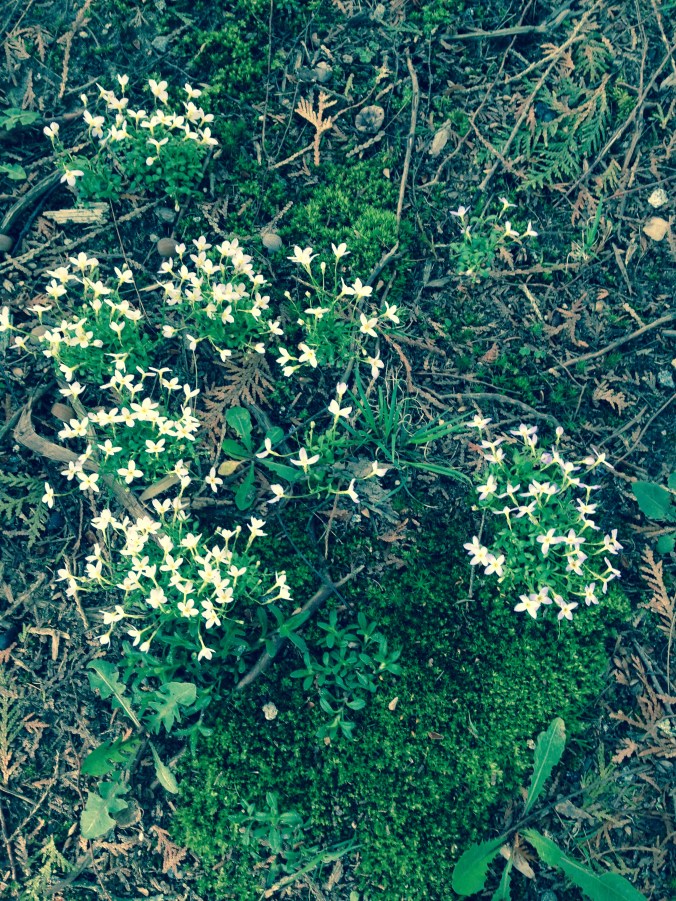
small white flowers

Somewhere along Bridge Street


Found nest

Spotted this nest today along the shore of one of the quarry ponds, near Plattwood Park


Timberdoodle versus Human: Which Singles Scene is More Exhausting?

American Woodcock

American Woodcock image courtesy of Paco Lyptic on Flickr

I don’t miss my single days—trying to look just right, the awkwardness of some conversations, disappointing dates, and being pursued by men who just seemed overeager.

Of course, that was a long time ago. And I don’t know for certain if it’s still the case that the men often take the lead—asking for a phone number, or a date, or trying to plan a “perfect” night. For all I know, the women are in complete control now! But, back in the day, I felt for these guys, with such an onus of needing to impress the girl.

Well, I’m here to argue that the American Woodcock (aka Timberdoodle or Bog Sucker) has a much more difficult time of it. For proof, if you are local, get to the Stewart B. McKinney Wildlife Refuge in Westbrook this Sunday for a repeat of this  past Saturday’s American Woodcock event—a brief talk and then watching the male do his elaborate courtship display.

Scientists or other exacting readers, please forgive me if this summary is less than 100% precise. But the male’s courtship job basically involves:

  • Calling out for quite some time (can you say PEENT?) while rotating in a 360-degree circle on the ground
  • Shooting up into the sky for an erratic (or maybe to the female, it’s erotic) flight while making strange whistling sounds with your feathers
  • Zooming back down while making another sound, described by some as “whimpering chirps” (is this desperation setting in?)
  • Landing in about the same spot, often to do it all over again (and again) (and again).

All of this is based on the assumption that there must be a female woodcock camouflaged in the brush, just waiting to meet you!

Here’s a good account, complete with audio, from Miracle of Nature.

If you can get to the local event, it is so worth it. It’s led by Patricia Laudano, president of the local Potopaug Audubon Society. She’s been developing her very specialized expertise in this species for many years! (If you don’t hail from Connecticut, it might be worth researching if there’s something like this going on in your area.)

It is a truly a treat to learn about these amazing creatures, their upside-down brains, and the labor-intensive ritual that makes human dating look like a cake walk!  Plus, to me they are uniquely enchanting. Bonus: they are an ungainly, endearing, persistent, and often unnoticed sign of spring!


Feeder Census and Fruit-Full Robins

Time moves differently when you are holding binoculars. Or maybe it’s when you are taking a bird census. All I know is that my total of 4 hours watching my feeder (broken up into 4 one-hour sessions) went quickly and amounted to a heartening experience of curiosity and delight.

How welcome and rare, in this day and age, to sit still and be entertained by something that doesn’t plug in or need charging! You can learn a lot by simply watching the birds in the yard, and be completely entertained, too. Some take turns, others take over. Some favor picking through the seeds that fall, others relish the suet cake or commit to a particular feeder hole. There are those who “dine in,” chowing down right on the perch, and those who “take out,” carting their seeds to an undisclosed location. Dimming sunlight looks especially lovely when reflected off of a mourning dove perched nearby.

I started to notice things like beak shape and gorgeous tail feather design and who likes to fly to what branch. Also, that you have to pay close attention to tell sparrows apart! The term “little brown job”  was invented for a reason!

Later on I flipped through the Sibley field guide Tom bought me, poring over details to make sure my identifications were on track. The whole exercise was a great reminder of how much there is to notice, how much there is going in nature that can just (literally) go right over our heads. Here’s a snapshot of my count from one of the sessions:

feederWatchSnip030616

This was the second year I committed to report my feeder eaters to Project FeederWatch, and I still have time to do a few more counts before the April 8 cutoff. I am hoping the next count will boast some robins. I swear I saw one fly by me on Route 154, but I’ve seen nary a one in the yard.

In fact, I felt a bit dumb when I had to admit that I had no idea where robins go during the winter. I mean, the consensus seems to be that they are a major sign of spring, but I was pretty sure that they didn’t fly south with the geese. Well, apparently I am not the only one who didn’t realize that robins often remain nearby when it gets cold, simply changing their habits. According to The Cornell Lab of Ornithology , in the fall and winter robins roost in trees and eat fruit, so we are much less like likely to see them. I would however notice if I saw a QUARTER MILLION birds in a roost! Apparently this kind of robinpalooza is a documented occurrence. Here’s some audio of a mere 1000 robins or so chattering in Arizona.

I don’t look at scrappy, scraggly trees tangled in the brush the same way anymore. I look for shriveled apples that have hung on, wondering if they will sustain a robin until he finds the ground soft enough for worms again.

Honey Guides, Bentonite, and Ayer’s Rock

My wanderlust is usually rather micro. I am often quite content with the many things to see and hear and learn on my local walks, in the many routes I can take without even without leaving Deep River.

Portage coverBut this week has got me thinking about nature that’s farther flung. I’ve finished reading Portage, by Sue Leaf, an account of the writer’s canoe trips north and west of here, including the Boundary Waters Canoe Area Wilderness, parts of Canada, Wisconsin, etc. (The only canoeing book I liked more was Yukon Wild!). The author devotes nearly two pages to bentonite clay, a substance that arises from ancient volcanic ash along rivers like the Little Missouri.

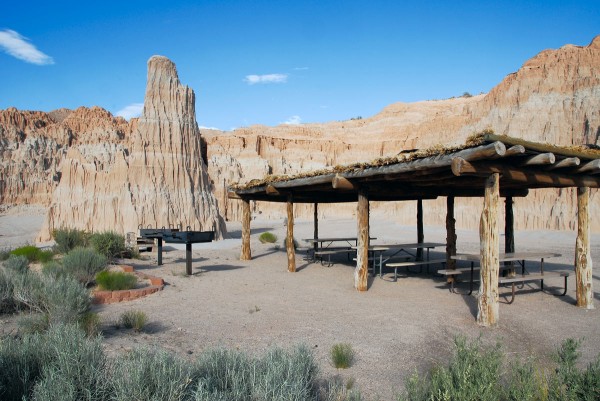
Cathedral Gorge is located in a long, narrow valley where erosion has carved dramatic and unique patterns in the soft bentonite clay. IPhoto/caption from Nevada State Parks site.

Cathedral Gorge is located in a long, narrow valley where erosion has carved dramatic and unique patterns in the soft bentonite clay. Photo/caption from Nevada State Parks site.

Of course, having to slog through the wet version of the stuff doesn’t sound like any fun; there are tales of clay stranding hikers for days or holding horses in place, but it’s cool to think about parts of the country that have great swaths of stuff I haven’t ever seen. This same nuisance-y stuff is treasured by herbalists, used in facial masks, toothpaste, etc.

Reading about bentonite also unleashed a dormant memory of a grade-school class trip to Caumsett State Historic Park Preserve, a treasure of Long Island’s North Shore. I’m not sure if I’ve created an exaggerated memory, but I seem to remember standing on a large “boulder” (for lack of a better term) of an unfamiliar substance, and our tour guide, perhaps a park ranger, telling me that it was sea clay. I was quite taken with its texture and the fact that it had appeared along the shore—I had spent so much time on South Shore beaches but had never seen this stuff.

Gavin’s been scooping up clay for years from the seasonal “stream” (basically a tract for runoff from the higher-grade forest spring thaw) that runs along the boundary of our property. This Stay Curious blog (great name for a blog, don’t you think!) has an account of the author’s discovery of little clay lumps (lots of them!)  along Bald Head Island beach in North Carolina. It got me wondering if my potter neighbor would be able to mold a work of art with them.

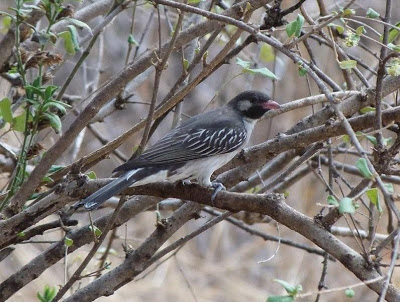
Greater Honeyguide photo reprinted with permission from Safari blog

Greater Honeyguide photo reprinted with permission from Safari blog

From my clay exploration route I hightailed it (virtually) to East Africa. Hadza: The Last of the First  is worth watching. It’s a well-executed documentary about the region’s last remaining true hunter-gatherers, whose way of life is threatened by encroaching civilization and government interests. There’s more than a blog’s worth to write about in terms of the tribe (see the movie!!), but from a naturalist perspective I was quite fascinated by the Honeyguide bird, which actually works with humans to lead them to hive sites. The humans extract the honey and give some of the honeycomb to the bird. This blog  does a great job describing how the interspecies communication and collaboration works.

My third jaunt in this salvo of armchair trips was courtesy of Bill Bryson. Gavin and I are both reading In a Sunburned Country for the second time (wow that guy can really write!). With the knowledge that Bryson is so very well-traveled, I took it quite seriously when he encouraged me to somehow find my way to remote Australia so I can see Ayer’s Rock in person. I could see that even Bryson struggled a bit to encapsulate exactly why this 1,150-foot high, mile-and-a-half long, five-and-a-half mile around “rock” left him astounded, declaring it was worth a 600-mile round trip.

Photo from Parks Australia on Pinterest

Photo from Parks Australia on Pinterest

The rock is technically a bornhardt, per the author “a hunk of weather-resistant rock left standing when all else around it has worn away.” After nearly 3 pages of noting that pictures don’t nearly do it justice, and that being there left him nearly inarticulate but somehow feeling that the rock was primordially, or even supernaturally, vastly meaningful, connecting with it in a nearly indescribable way, he was forced to wrap it up by saying, in uncharacteristically monosyllabic fashion for such a wordy guy: “Go there, man.”

From my chair, out West and on to East Africa and Australia. All of this almost topped the local adventures to follow here at home: cormorants through my binoculars, hungry birds encircling the feeder, long walks in the surprisingly mild late November air. Thankful for adventures outdoors, both far and near,  vicarious and in the flesh.

Join the Club (Moss)!

One of the best things about being out in nature is the absolutely limitless supply of opportunities to learn. On par with that plus are the many reasons for hope and delight to be found in places as seemingly humble as the forest floor.

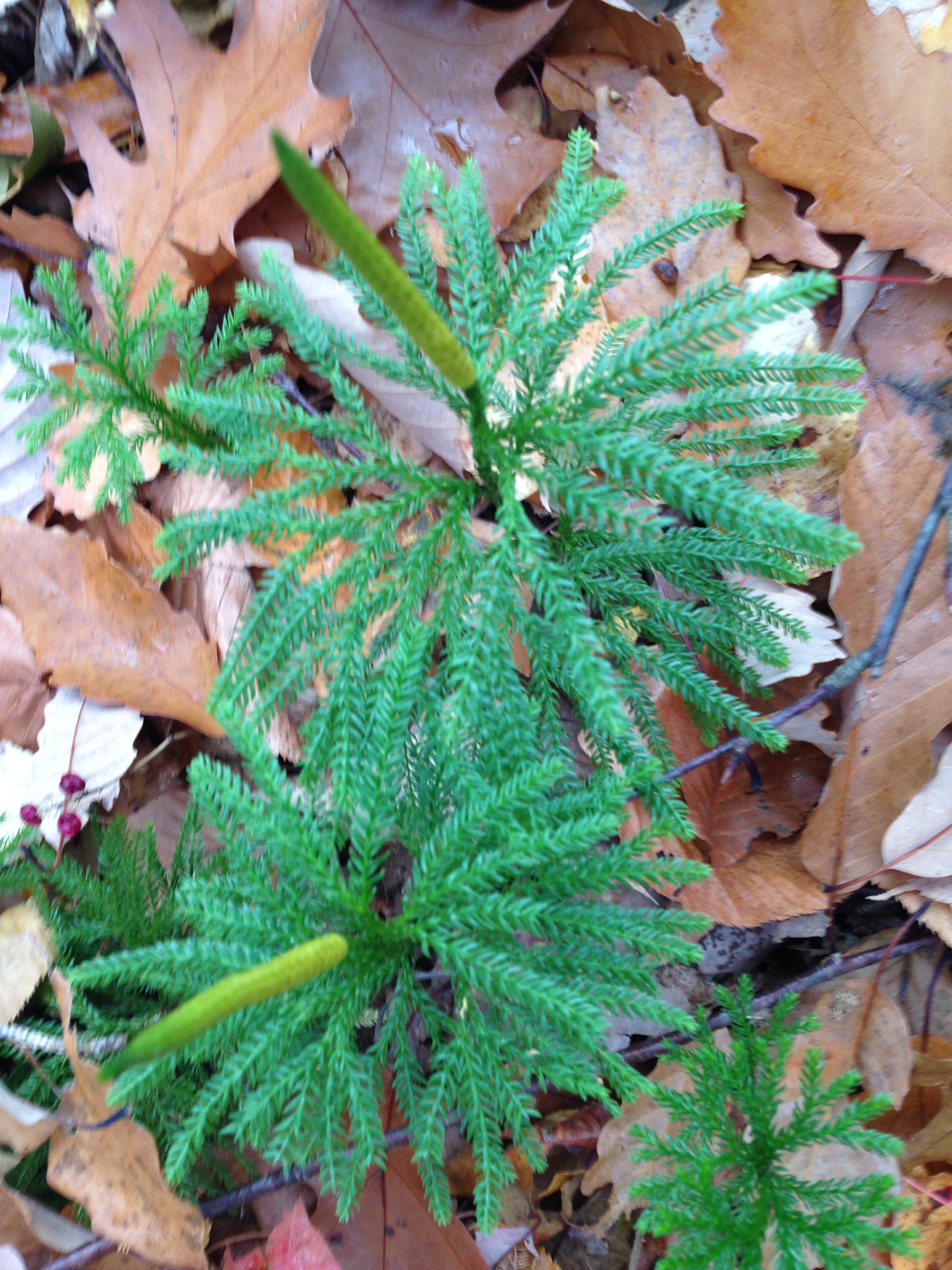
My latest study—and also hopeful venture—is club moss. This link leads to the inaturalist page for Connecticut club moss sightings. I am particularly enamored of running pine moss, which really does look to me like a little figure that’s about to dash off a la the Gingerbread Man of childhood story books (it’s pictured in above link)! But most often, in the Cockaponset State Forest behind our house, I see princess pine:

2015-11-05 07.54.11

According to inaturalist its spores used to be used as flash powder (in early photography or magic tricks ). I know if I tell Gavin he’ll want to try that out pronto, and preferably with bushels of spores. Come to think of it, some adults I know would be right on that, too. (Can’t vouch for how to do this, or for safety. Also, some states list the plant as endangered, likely a result of earlier enthused harvesting.)

This Massachusetts land trust’s site has a nice write-up about the princess pine. What I like best about this diminutive species, which is not a pine at all, is its evergreen-ness. It comforts me when I think ahead to the depths of winter. It is also such a pretty and precise-looking plant.

Before I read The Beginning Naturalist by Gale Lawrence, I’d assumed that the princess pine and other similar club mosses were baby evergreen trees. But they are already fully grown, and they are not in the conifer family. Confusingly, the club mosses are not mosses, either. They are closer to ferns. The “club” refers to the club or spike that shoots right up from the plant—it is coated with a fine layer of spores. The growth from spore to mature plant takes a full 17 years, but some plants can also grow by sprouting along the same stem.

Gale Lawrence’s chapter on these plants amused me, because she refers to the “attacks of the Christmas decorators.” Determined crafters let loose in the woods can pull up whole long underground stems of club mosses for weaving into wreaths, wiping out that impressive life cycle with one good yank. Even without the greenery of Christmas in mind, it is a bit tempting to imagine taking one of these miniature (non) trees home. But the happy-seeming plant has worked too hard to become a pet. Best to visit it in its “home in the loam,” beside its mushroom, acorn, and looming tree neighbors.

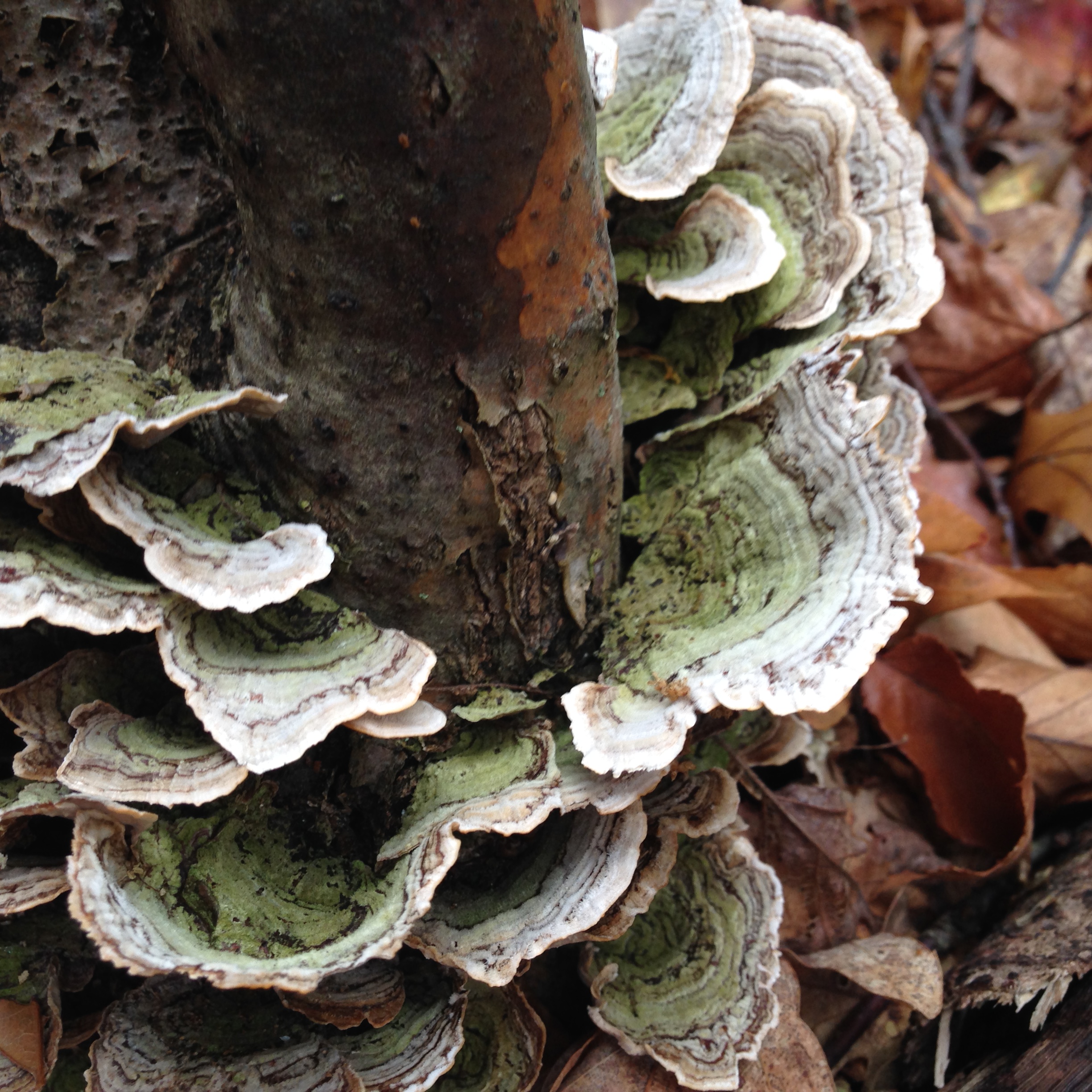
BONUS photo for those who read to the end! 😉 : the decorative lichens (or could they be mushrooms??) adorning a stump in our yard! This is just a bit blurry, but I can’t be the only one who thinks these are simply gorgeous.

2015-11-10 07.25.39


Indian Summer: Just 9 Days

Web photo (mine)I’ve tossed the term around since first hearing it in childhood: Indian Summer, indicating a surprisingly warm period after we’ve already had a cold snap. Well, I got the general idea right. But according to The Old Farmer’s Almanac, Indian Summer must technically fall between November 11 and November 20. So as I write this, we’re almost at this very specific window, although I do wonder if the Almanac people do any adjusting in light of climate change! There are more criteria than just dates, though:

“As well as being warm, the atmosphere during Indian summer is hazy or smoky, there is no wind, the barometer is standing high, and the nights are clear and chilly…The time of occurrence is important: The warm days must follow a spell of cold weather or a good hard frost.”

Why the term “Indian?” The Almanac’s prevailing opinion is that it refers to how the Native Americans could have “one more go” at the early New England settlers when the weather turned warm again. I prefer the story about the early Algonquians’ belief that the warm weather was sent by their southwestern god, Cautantowwit.

lichenWhether or not it’s fallen into the prescribed time period, creatures great and small here in Connecticut have been enjoying this reprieve from the autumn chill. Just a couple of weeks ago I awoke to find our porch begonias dead from the overnight frost, their rosy blossoms “bleeding” onto our yellow railing. But then it turned positively balmy again. Over the last week or so I’ve seen bees lingering over the asters. I photographed a jewel of a spider’s Web on our front hedge. And I’ve walked through the Cockaponset (conveniently located behind my home), admiring its generous décor of mushrooms and lichen. These moments, usually grabbed after Gavin gets on the bus and before I have to drive to work, are deeply appreciated as the days get shorter and the trees shout out their gold and orange songs.

One day, I was in a cranky mood and was positively stopped in my tracks by the gleaming gold in the afternoon sunlight outside. I really felt that I was being shouted at, reprimanded by beauty: how bad can it be when I’ve got this display right outside my door?

gold leaves

Robert Frost said it best: nothing gold can stay. But isn’t that why we treasure it so?:
Nature’s first green is gold,
Her hardest hue to hold.
Her early leaf’s a flower;
But only so an hour.
Then leaf subsides to leaf.
So Eden sank to grief,
So dawn goes down to day.
Nothing gold can stay.

Preserves and Professional Parks

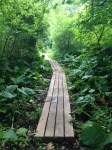
path in woods startMy friend Chris asked me recently about my week-long nature writing residency at the Trail Wood memorial preserve, and the first two words that came to mind were “life-changing.” I reveled in the chance to be in nature alone for extended periods, to contemplate, to write and rewrite, to read the treasured words of Edwin Way Teale in his very home, his very office—a sacred place to me! For the first time ever, I used up the camera storage in my iPhone. This blog isn’t big enough to contain the wealth of images, so I’ve scattered a select few throughout the post.

butterflyfuzzy mushroom lichenOf course, Trail Wood had many creatures and plants that I don’t see every day. The Beaver Pond became my favorite destination, and one morning I watched one of the beavers having an early swim. I took photo upon photo of insects in both meadow and forest, but I wasn’t usually swift enough to capture the many birds digitally. I looked forward to daily sightings of the woodchuck who lived near the house. My suburban New York roots showing, I sang to myself in the woods and carried pepper spray just in case the reported resident bear didn’t like my performance. (Maybe the bear wasn’t as exotic as it seemed. There have been several reported sightings in Deep River neighborhoods recently!)

Teale cabinAn absolute gift of the preserve was its undisturbed quality. But another gift I took away from my time there is the practice of really looking and listening even in places that haven’t had the benefit of such thoughtful stewardship. I  take small walks around the office park where I work, not by any stretch a nature preserve. Still, I smile at the abundance of Carolina locusts behind the buildings (who don’t seem to be doing any noticeable damage), and the occasional spotting of a raptor, bright bird, dragonfly, or hornets. I look down into the wetlands below the tall hill. Once in a while, I see a deer. Just once, I rescued a young raccoon who was clattering around in the nearly empty dumpster, watching from a distance as he climbed the long birch limb escape ladder I’d lowered for him.

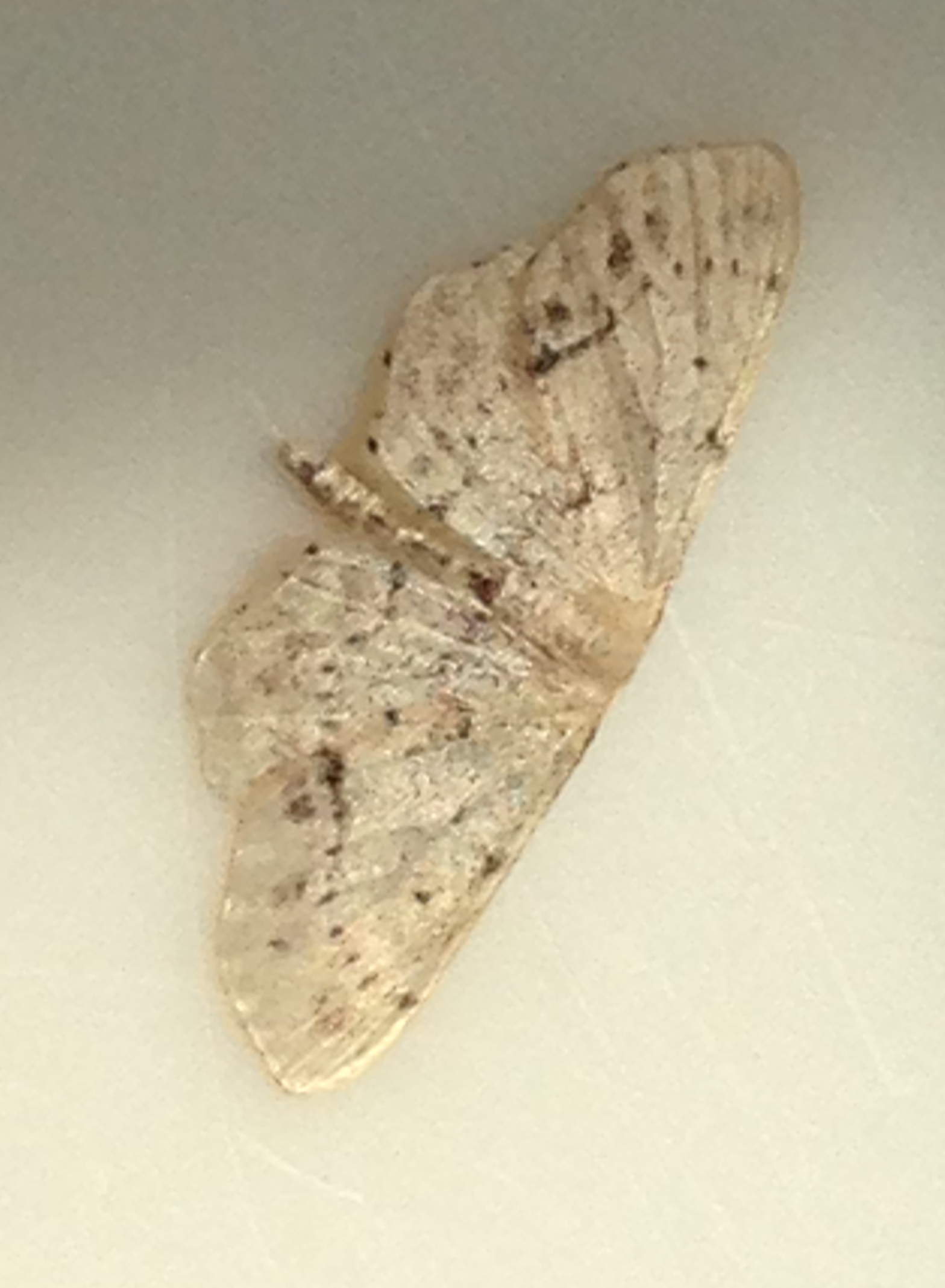
Just the other day, I snapped a picture of a delicately decorated moth (looked like the oversized Oriental vases my grandfather had around his house) who turned out to be an ailanthus webworm moth. I love it when nature comes right to my door!

alianthus web worm

While staying at the Teale home I was drawn to a book of Mr Teale’s that I hadn’t read before: Days without Time. The edition on the study shelf was dated 1948, just 3 years after his son David was killed in World War II. Teale’s introductory words ring so very true:

The fall of the tree, the swoop of the hawk, the tilt of the buzzard in a windy sky, the song of the hermit thrush at evening, the opening of a windflower, the eddy of a woodland brook—all of these are events for days without time. They might have occurred during any one of a thousand or ten thousand years. Ticking clocks and factory whistles have little to do with the eternal recurrence of these eternal themes.

Something for me to remember after my New Hampshire vacation, chock full of walks in shallow streams and visits to waterfalls: when the “factory whistle” is again in play, nature doesn’t live only in preserves or the areas we think of as great sightseeing locales. It is everywhere. With eyes and ears wide open, every day is a new chance to notice it, to give it the full attention that it deserves. With that attending we find ourselves more connected and more alive.

Moths, Mushrooms, and Umwelt

Lately, I’ve been reading Central Park in the Dark, by the same author (Marie Winn) who wrote Red Tails in Love. Her reports of a robust animal and insect world thriving right in midtown Manhattan are such a comfort to me. And they remind me that, with nature, there is always much more going on than what we notice at a casual glance.

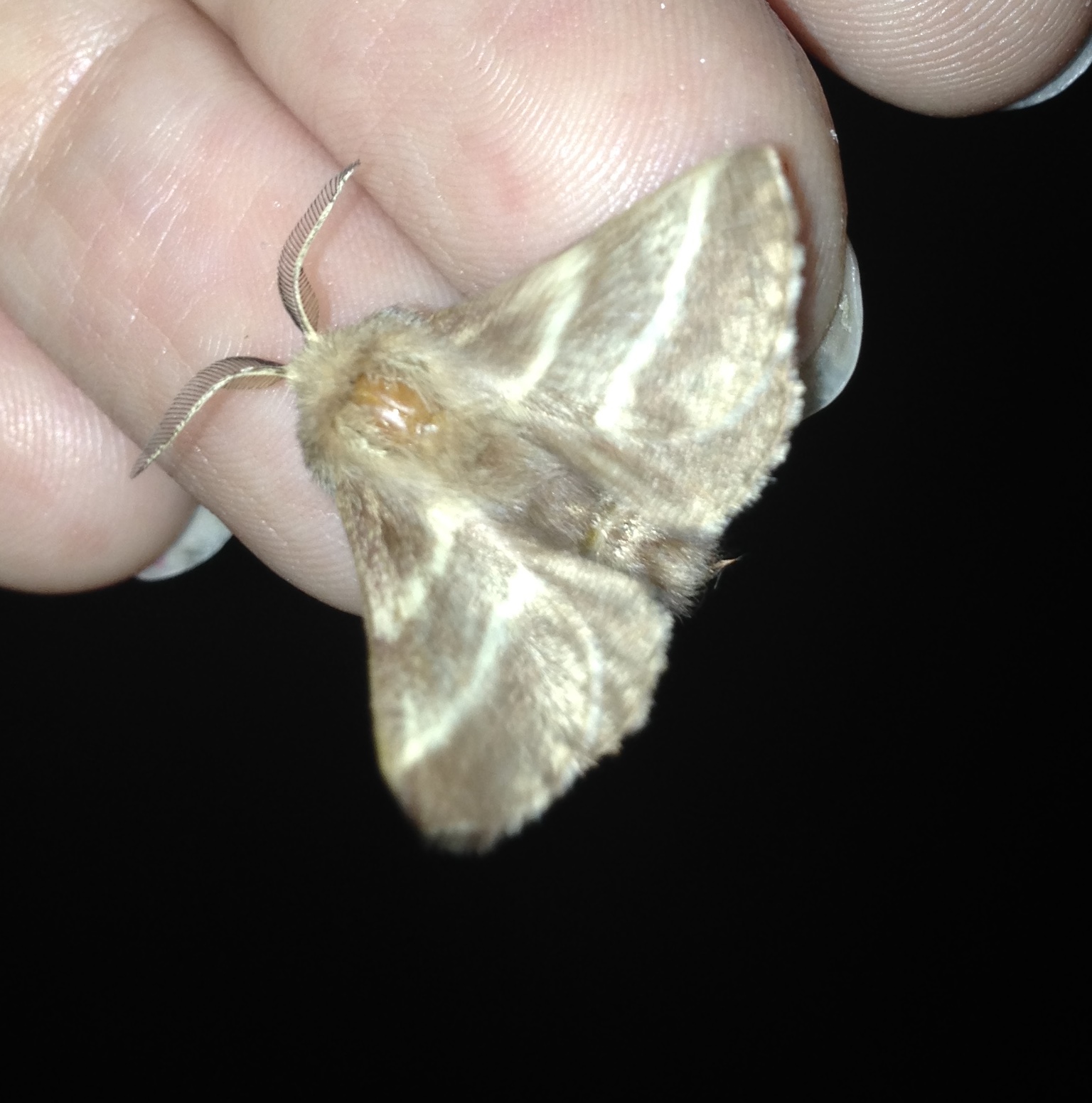
white mothTake moths, for example. They have always loved my porch, but this year they are finding their way inside more, to the grow light that overhangs my modest crop of hydroponic tomatoes. They flitter their way into the sink way too often—are they seeking hydration or just attracted to the water’s glimmer? In any case, I have made valiant, if not always successful, efforts to rescue them. The antique milk can on the porch has become a moth rehab facility–a place where they go to dry out. Bonus fact, which I learned after writing a poem about moths alighting on my arms: they crave the salt in our skin! We might not think as kindly of them if they found ways to extract it the way female mosquitoes, or ticks, access what they find to be our most alluring qualities.

iridescent moth

I was reminded, however, by the Central Park book that most moths’ lifespans amount to less than a few weeks. This greatly saddened Gavin, so I told him about something else that I had learned about: the idea of umwelt. A musty but lovely second-hand book I found, The View from the Oak (Judith and Herbert Kohl), talks about a term used by another nature writer “to describe the world around a living thing as that creature experiences it.” Imagine, for example being an ant, living your whole life in a particular corner of a field, pebbles like boulders to you and your vibratory sense your only means of communication. That experience, that way of living and perceiving, is your ant umwelt. I apply that same concept to time, too. The moth that lives its full few weeks is likely not comparing itself with humans and crying over its piteously short stay on the earth. We humans have our own time umwelt, so we don’t tend to bristle over the lifespans of Galapagos Giant Tortoises, who live for upwards of 100 years (or Ocean Quahogs, who can live for 400+!).

Another umwelt I found myself wondering about was the perspective of the slug. Of course, I’ve seen slugs here and there throughout my life, but only on a recent jaunt at Fountain Hill did I notice groups of them sitting on mushroom caps.

mushroom with several slugs

Can you see the 4 slugs feasting?

How long did it take them to climb up there? Was it like summiting a high mountain peak? It made me wonder if slugs eat mushrooms, and the article I found from a 2010 issue of Fungi was called What We Don’t Know About Slugs and Mushrooms—the scientists seem pretty clear that slugs eat fungi but not so clear on specifics. One of the problems is that it’s the mushrooms, not the slugs, that are usually the subject of any the available photos that might prove slug fungus consumption, and most of the time photographers don’t want to photograph the slugs at all. It’s not just with most photographers that slugs get a bad rap—and I understand that they eat our garden greens—but I do think that if they were better looking they might be treated better. Hopefully in their own little slug umwelt they don’t realize how their slimy looks count against them. But if they do, Gavin reminded me that there is an Ugly Animals Preservation Society that they can turn to for support.

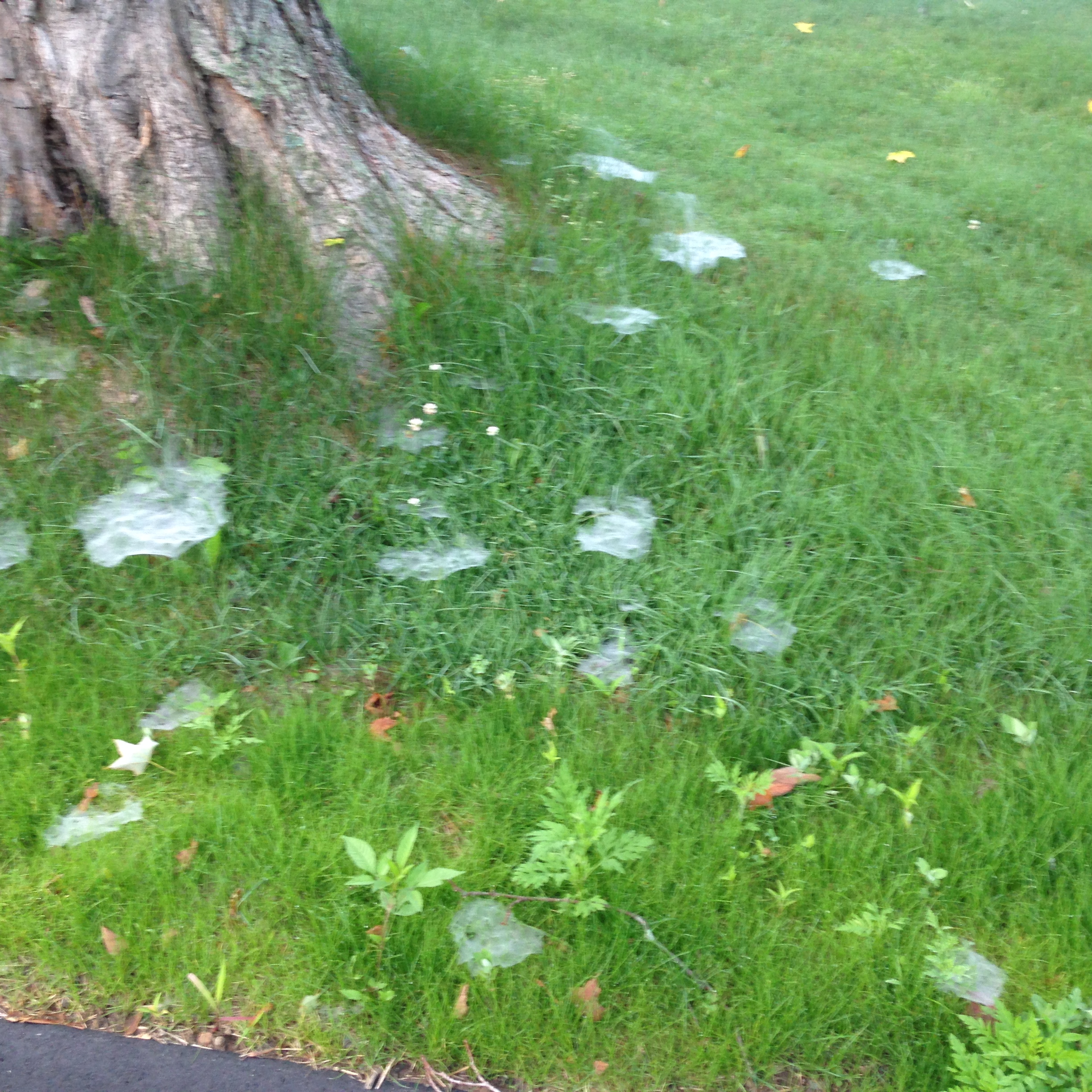
July is such a rich, moist, spilling-over-with-abundance time in Connecticut. This morning I counted 13 rabbits on my walk down to Town Dock, and funnel webs from the grass spiders, highlighted by the dew, dotted nearly every lawn—an uncountable array of spider condo complexes. My own, personal umwelt is a happy one because of this.

I count at least 19 funnel-shaped webs in this small patch of lawn

I count at least 19 funnel-shaped webs in this small patch of lawn