Nature (and Nests) Laid Bare

TealeCabinSaturday found Gavin and me wandering around the Hampton, CT, Audubon Society at Trail Wood pathways. They encircle the former home and writing cabin of nature writer extraordinaire Edwin Way Teale.

The day was a gift. We relished the balmy 51 degrees of an unseasonably comfortable late December day. We signed in at the information building, musing over the many visitors that have walked these trails over the years. We looked up the day Gavin was born–yes, someone had been hiking there on that very day in 2002! Some guest entries provided great detail–2 beavers at the pond, deer on the path, beautiful autumn colors. Someone had left a large paper wasp nest (now abandoned, of course) on the table, alongside maps, books, and magazines to educate the visitor, including this Connecticut Woodlands issue on the former resident nature writer. Teale wrote A Naturalist Buys an Old Farm at Trail Wood; the book about his time at these 168 acres of ponds, woodlands, and pastures was the Christmas gift to which I treated myself.

TealeCabinLittleBeaver

One of my goals this year is to make myself more hardy, so I am more apt to get out when it is colder than my current set point of 40 degrees. For super frigid days, I have my “Cabinet of Curiosity” to pore over–a box that Gavin decorated into which we’ve deposited egg shells, snake skins, fungi, lichen, nuts, butterfly wings, and all matter of other nature finds.

nests

A few items from our shoebox collection

Among the collection are several nests, and it occurred to me as we wandered the woodlands that sighting of nests is a big bonus of wintertime, one even the most cold-averse explorers can appreciate. The leaves are gone, and revealed among the bare branches I see large paper wasp nests overhanging the road, squirrel’s nests high up in the forks of trees, and plenty of abandoned bird nurseries. I like to think about when and how they were built. Squirrels’ nests always look like quite a messy affair to me, so I was tickled to read in West Virginia Wildlife Magazine about how much care and planning goes into them:

Construction begins with a platform of twigs roughly woven together, upon which damp leaves and moss are compacted to form a solid base. A spherical skeleton of interwoven twigs and vines is erected around the base. The outer shell is then completed with the addition of leaves, moss, twigs, and even paper.

I have new respect for the squirrels, and great hopes for more outdoor “nest safaris”, even when the temperatures dip a bit lower. Of course, when the weather warms again there will be new nests with new occupants. It will be fun to find those, too, although of course they must be viewed from afar. Here’s some advice on the pursuit from the Cornell Lab of Ornithology.

Morning with Raptors (Soundtrack included)

One morning recently, when it was just barely light, I stopped the electric toothbrush to listen. Unseen, coming from a tree over the garage, an Eastern Screech Owl cried. I am a truly amateur bird watcher and listener, so I had only a faint idea about what I was hearing. But the nice thing about being an amateur these days is that you have a world of resources just a few key strokes away. To me, the screech sounded like half whinny, half screaming woman—it sent a chill of alarm through me before I figured out that it was a raptor. Here’s a link to the audio. The dramatic, human quality of the call reminded me of the start to Mystery on PBS years ago (the part of this video where the helpless woman is crying in distress from atop, for some reason, a large tombstone. Creepy, with Edward Gorey graphics.)

I loved the unexpected treat of this unseen visitor. That owl sat on the same branch, I think, where Gavin had once spotted a juvenile bald eagle, in all its magnificence, looking down at our garage. (we have mice and chipmunk visitors to the garage—has the word spread in the bird of prey community?). I was so impressed I had to try a poem that day (it’s at the bottom of this post).

What was it about this particular Saturday morning that had the raptors showing themselves to me? A half hour after the Screech Owl, I was only two blocks into my walk when I pulled out my iPhone to try to record a Red-Shouldered Hawk at the very top of a tall pine. My friend Chris paused her own walk to stare up and take photos with me, and I had a new appreciation for nature photographers/videographers. Of course, I had no zoom lens, but to even get just a recognizable profile I had to wait, patiently, until the guy (or gal) turned his/her head. And I started to feel like the bird was intentionally withholding its call now that I was trying to capture it. I got a neck cramp watching and waiting, but finally it graced me with its song and I hit the “record” button with success. Here’s a link to hear what the hawk sounds like (my free version of WordPress won’t let me upload videos, but I am quite proud of my own recorded song). Here’s the best picture I managed (as handy as the phone camera is, I am putting a compact camera with zoom on my wish list):redShoulderhawk

Last year, Gavin and I attended an Audubon Society “Owl Prowl”—a nighttime walk in the freezing cold led by an expert birder and caller. The only owl we saw and heard was the baby one they were rehabilitating inside—I think it may have been another Eastern Screech (I remember its fluffy ear tufts). But it was endlessly amusing to witness this 50- or 60-something woman expertly contorting her vocal chords to cry out like an owl. I don’t remember her doing the Eastern Screech call though—that would have been an impressive feat. I see there’s another Owl Prowl in the works (this one in Milford, CT, but, for locals, I bet others will be scheduled soon—watch the Audubon Web sites).

And this strays from the raptor topic, since I’ve never seen a raptor at my bird feeder, but Project FeederWatch, an opportunity to be a citizen scientist and tune in more to birds even as the winter weather zooms in (an initiative by Cornell Lab of Ornithology and Bird Studies Canada) is underway. Participants are asked to select 2 feeder watch days at least a week apart, and record what they see. If you get into it, winter also brings the Great Backyard Bird Count in February 2015. I am not a cold weather lover but the distraction of birding makes it a much more enriching time for me!

Wishing you your own morning with raptors, for it truly is a gift to be visited by these magnificent creatures.

Should I remember anything of this day,
it will be the bald eagle on bare branch
framed against the Sunday afternoon sky

Watched me watching him,
nearly motionless,
incongruous in his largeness

Stayed during my afternoon nap
(perhaps he had one too),
screeched as I roused,
just before he flew

I searched each limb from
every pane of my own aerie

Found him again between
the spaces in this poem

Going to Seed

By Slack12 in Guilford, CT

By Slack12 in Guilford, CT

It is a gift to discover a new and inspiring place, especially when it’s right in your own backyard and especially on a stunning autumn day. The Stewart B. McKinney National Wildlife Refuge—the Salt Meadow Unit —is a short drive away in Westbrook, and our family was treated to a talk on fall foliage and a walking tour along the loop trail by the park rangers last Sunday. It was past peak, but the talk on what makes leaves green (chlorophyll) orange (carotenoids), brown (tannins), and red (sugars), and on the trees’ wise practice of conserving their resources for the winter gave me a newfound appreciation for the many autumns I have watched come and go.

In many cases, the bright green chlorophyll of the growing season is actually masking what the tree’s true, inherent leaf colors are. In other words, the beauty that’s been masked emerges as the leaves near death. This concept had me thinking about how this can often be true for humans, too–our “bests” do not necessarily appear when we are young and occupied with the business of growing and reproducing.

I cherished the rich scents of salt and mud and plant life wafting up to the viewing platform over the marsh, and I marveled at the mix of trees and their colored flags of surrender to winter. I became fascinated by the lives of the two women who had bequeathed the land so that it could be preserved. They ate at a grand stone table in a clearing overlooking the water; they even had an outdoor icebox nearby so they could linger outside longer.

As our varied group of families, couples, and singles stood in the sunshine within a tunnel-like walkway through tangles of low brush, the ranger explained that this shrubland was an endangered habitat, one that is being carefully managed and monitored. Years ago the natives burned swaths of land for clearing and other purposes, and after that farms had their own clearing effect, removing shade so that shorter plants could thrive. But now, in New England, much of the former farmland has been developed for housing or industry, and that means less shrubland overall. Diminished shrubland means less food and less cover for a variety of animals, like the declining American Woodcock and the endangered New England Cottontail.

From the Maine Department of Fisheries and Wildlife

From the Maine Department of Fisheries and Wildlife

There’s something to be said for letting things “go to seed.” The idiom has a connotation of negativity, perhaps especially in New England when clearing land meant labor-intensive walls of heavy stone. UsingEnglish.com says “if someone has gone to seed, they have declined in quality or appearance.” But in the case of shrubland and in defiance of this judgmental idiom, species can thrive if completely cleared land is allowed to return to its more natural state—at least for a time. And the tangles, twists, berries, and bugs that emerge have a subtle but seductive beauty of their own. Those of us with our own yards can pitch in, too, creating and/or preserving our own small shrubland patches.

I’ve been reading Living at the End of Time: Two Years in a Tiny House by John Hanson Mitchell, and I savored his account of encouraging a new shrubland after he had some trees cleared and their stumps bulldozed. How reassuring the relentless march of life can be:

I let the area grow up again. First to return were the poison ivy shoots and the blackberries, which, although ground down to nothing on the surface, had their roots deeply set in the topsoil. But this time other species came along as well, and….toward the end of that summer I counted the number of species in my first informal ecological survey. In subsequent years in the meadow I found brown snakes, red-bellied snakes, garter snakes, and milk snakes. I saw leopard frogs, pickerel frogs, wood frogs and toads, red-backed salamanders, katydids, meadow crickets, long-horned grasshoppers and uncountable species of beetles. Foxes and skunks regularly crossed the meadow; deer grazed there…Robins and flickers were abundant; flycatchers darted from the trees along the edges to snap up the field insects flying above the ground; swallows coursed the clearing by day, followed by bats at night. There was light and air; stars, wind, and sky; life had returned.

Central Park West, The Climate, and the Crowd

ClimateMarchSept2014I didn’t have one of my nature walks Sunday, at least not the kind with solitude and a soundtrack of late summer birds and crickets amid a subdued Connecticut neighborhood. I did walk, very slowly, from 86th and Central Park West down to 34th and 11th,  and I had lots of company. Almost 400,000!

I prefer my walks alone, but Tom and Gavin, and another 399,097 or so others came along to say something about climate change. I’ve been reading about nature and the earth long enough to know that this is not just a passing trendy belief. The climate really is changing, and not in favor of living things. There’s no longer a credible debate that says otherwise, and I was happy to see a lot of scientists, complete with lab coats, in what one recently interviewed joiner, the highly credentialed Peter deMenocal (Professor, Department Earth and Environmental Sciences, Columbia University), proudly called “a nerd parade”.

People had lots of solutions and motives on their signs—they marched for the birds, for the arctic, for their grandchildren, for simple living, for socialism, for radical revolution, for conservation organizations, with their churches—a huge variety from confrontational (although as far as I know there was no violence) to peaceful, from tree huggers to pragmatists. But the group was united in that they recognize a genuine problem and are trying to raise awareness and push for solutions. And there are some solutions–but we are at a point now where governments must act to effect real change, along with each individual doing his or her part. Here’s a good summary of broad solutions by National Geographic. And here’s a link about actions to consider at your own individual level. The march preceded the UN Climate Change Summit, calling for urgent action, globally, in response to the problem.

CLimateMarchBUGThe first arm of the People’s Climate Change March ran along Central Park West, and I liked looking up at the grassy hills, people climbing streetside boulders, and the ubiquitous pigeons, who seemed to be watching the noisy human display with great interest. A bug hitched a ride on Gavin’s sign for quite a few blocks, and I imagined him shouting “we are here!” (as in the iconic Horton Hears a Who), a microcosm of what the marchers were doing! We also enjoyed occasional trees and gardens perched atop some of the tony parkside buildings. Even in crowded Manhattan, nature has a way of inserting itself.

Pretty good stick imposter: my first sighting besides the indoor creatures at Audubon Glastonbury

Pretty good stick imposter: my first sighting outside of the indoor creatures at Audubon Glastonbury

Back in CT a friend at work pointed out a stick bug hanging out by our office entrance. I’ve never seen one in “the wild” before—surely because they blend in so seamlessly with the plant life! Today a coworker’s kids reported to me that they saw a parakeet flying around outside, and in return I showed them my pictures of the stick bug. 2014-09-22 13.36.51

Speaking of kids, they really are the future,  although I risk sounding like an 80s pop song when I say that. But see for yourself: the winners of this video contest got to go to the UN Summit.

Aster Place Comes to CT

Astor Place in New York (Cooper Union building) by David Shankbone

Astor Place in New York (Cooper Union building)
by David Shankbone

I went to school in Manhattan for a while, and Astor Place meant a street in Greenwich Village, named after the incredibly wealthy John Jacob Astor.


Aster Place in Deep River

Aster Place in Deep River

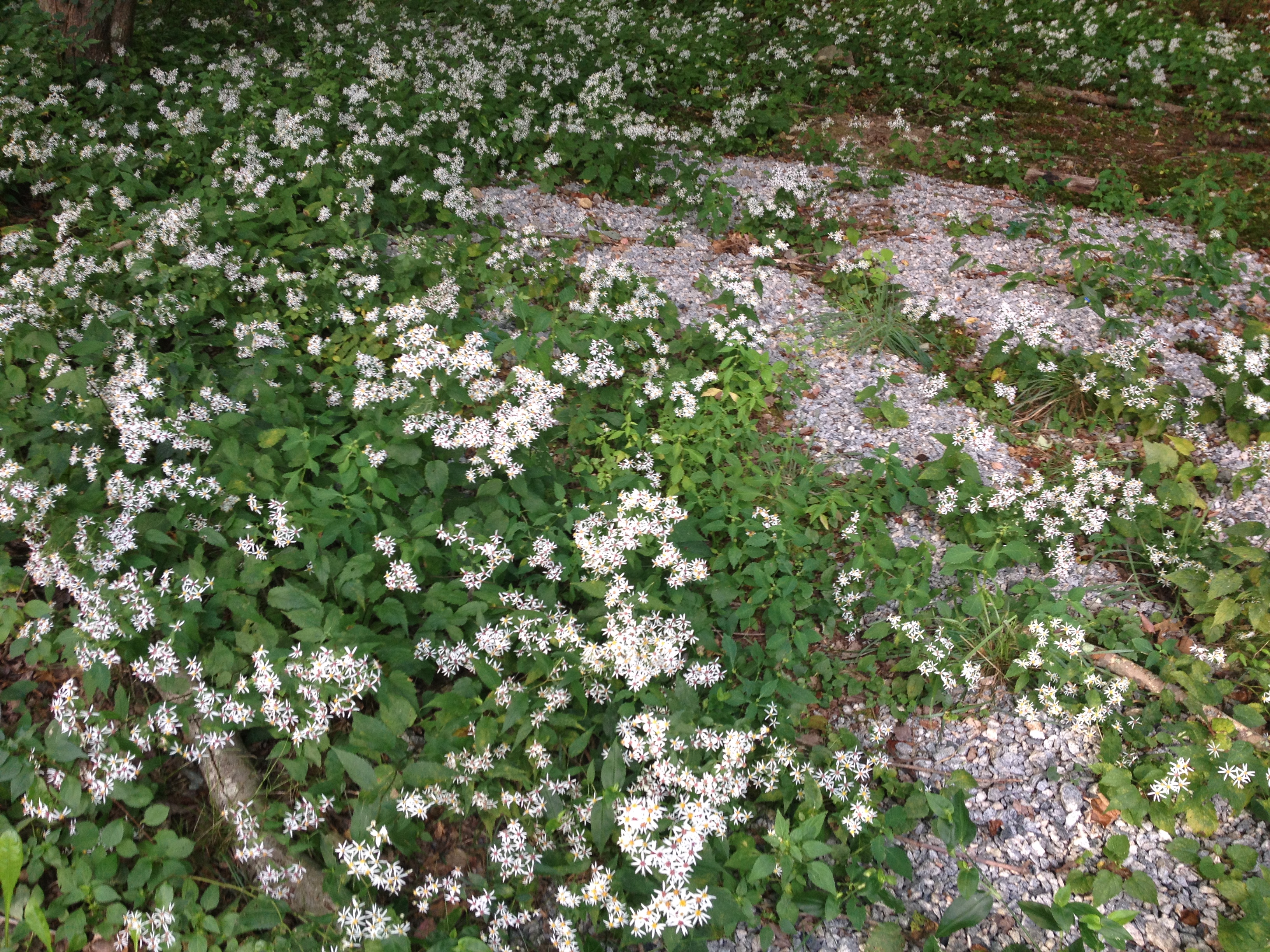
When I pulled up my driveway earlier this week, I nearly rubbed my eyes to check my vision. Beyond the comforter and sheets bobbing on the clothesline, and further back, beyond the French drain to the mossy, moist part of the yard, was a sea of white stars. Uncountable asters had grown up, seemingly overnight. We’d never planted them; they just are; a visitor that comes every year as autumn approaches.

Toward the end of last autumn I picked a brownish, aged aster and placed it in a cobalt blue vase. My husband tossed it, thinking it was a bud that had stagnated from neglect. But I saved it because, even well past its prime, it had a modest, stalky beauty, well preserved. It was stalwart after summer ebbed, and I had to give it credit for its staying power.

The common name for the aster flower, which can bloom in white, blue, or purple, is the Michaelmas daisy, so named because it coincides with the feast of St Michael the archangel, according to Herbs Treat and Taste. The site also tells me that Virgil, some years before the start of AD (or Common Era), wrote about the flower, alluding to its use on holy shrines. I treasure the timelessness of these words nearly as much as I do gazing down out our bumper crop of stars:

There is a useful flower
Growing in the meadows, which the country folk
Call star-wort, not a blossom hard to find,
For its large cluster lifts itself in air.
Out of one root; its central orb is gold
But it wears petals in a numerous ring
Of glossy purplish blue; ’tis often laid
In twisted garlands at some holy shrine.
Bitter its taste; the shepherds gather it
In valley-pastures where the winding streams
Of Mella flow. The roots of this, steeped well,
In hot, high-flavored wine, thou may’st set down
At the hive door in baskets heaping full.

Woody Guthrie, Robert Frost, and The Mountain

cattleAt long last, we managed to get ourselves down to southern Virginia this summer, a trip vastly overdue and a time to reconnect with family. There are other chapters to be written about ties that bind and family history, but this one is about the land.

When we woke, whether we looked out the front or the back window, there were cattle, and, once, a young buck grazing among them, pretending at being a steer. Aunt Norma, dealing with medical issues and unable to take the journey herself, emphasized the importance of going up the mountain, and cousin Mike took the men on the long drive up. Cattle were fed; pictures were taken. I remember going up there as a child and picking wild strawberries, and turning strong lights on at night so we could see the deer. Mike’s father, and the grandfather we share, raised cattle, too. I’m told my father cowboyed out west, summers, and it helped pay for school.

I didn’t go up the mountain, but I sat overlooking the hills in the mornings, and one day walked up the dirt road—more cattle to visit but also the hum of crickets and birds, tangles of wildflowers, and unfolding curves that beckoned me. Trees waved in the gentle breeze and I thought of my father, who also loved this land. I visited the cemetery, where he and many of my other relatives’ tombstones nestle in the green grass, the markers weathered and hosting lichen and moss, not far from the mountain.

Woody Guthrie was right—this land is our land . But so was Robert Frost in The Gift Outright —“the land was ours before we were the land’s.” His poem, an inaugural one for John F. Kennedy, talks of nations and war, and my people were part of that story, too. But this part makes me think of the mountain, and how it owns us all now:

Something we were withholding made us weak
Until we found out that it was ourselves
We were withholding from our land of living,
And forthwith found salvation in surrender.
Such as we were we gave ourselves outright

I’m told there are some cousins, most of whom I’ve never met, who aren’t especially attached to our family’s mountain. But I am so glad for those who have given themselves to it, seen the grace that it holds; longed for, sought, and found wordless connection there. We are the land’s as much as the land is ours. And the connection we feel comes with responsibility; if you spend enough time in nature this realization becomes unavoidable. Teddy Roosevelt, another lover of mountains, said it well:

The Mountain (Hampton)Here is your country. Cherish these natural wonders, cherish the natural resources, cherish the history and romance as a sacred heritage, for your children and your children’s children. Do not let selfish men or greedy interests skin your country of its beauty, its riches or its romance.

And Gary Snyder has summed up the way that many feel; the way that I felt in Virginia although I was hours away from my house and usual environs:

Nature is not a place to visit. It is home.

Rich in Raspberries

2014-07-31 07.10.08

I’ve got to give my son Gavin credit for this blog’s title, and top billing in this week’s photo, too. He mused aloud that we were “rich in raspberries” as we industriously filled two sandwich bags with our picks from a tangle of roadside bushes. They were a bit of breakfast, and later, at the close of the day, dessert with whipped cream.

We had to consult a friend to be sure the berries we saw springing up everywhere were safe. Our Backyard Foraging book neglected this particular species, and I was seriously afraid that there might be imposters that looked and smelled like wild raspberries but were actually an artfully disguised malevolent toxin that would leave us gasping for breath. But once we got the all clear, the worst thing that happened was a little patch of poison ivy on Gavin’s arm, a small price for the juicy pleasure of the experience.

On the way up the hill to our best picking spot, we saw a wealth of small birds and a duet of deer, and realized that they, also, were probably relishing the seemingly unceasing red harvest. Something about eating right from the bush, and about sharing the joy with a bevy of creatures, made the berries taste that much sweeter.

Amidst the satisfying pick, I also felt sad when thinking about how removed from the land most of us have become. On the other hand, there remains a stalwart cadre of faithful kitchen gardeners, and foraging seems to have picked up in many sectors, to me a powerful sign of the collective desire to reconnect with the good earth. Recently, I took great pleasure in the book Closer to the Ground, particularly relishing its tales of a family’s catches from the Pacific Northwest waters and coastline.  I thought back to a piece I wrote years earlier surrounding an older book by Nelson Coon, called Using Wayside Plants. Coon was inspired by William Miller, a hobo who dug himself snug places to sleep below the snow, tapped sugar maples with hollowed elderberry twigs, and chewed black birch bark to stave hunger. The read was rich with recipes for sorrel and nettle soups, ink cap mushrooms dug from the roots of trees, clover bloom vinegar, elderberry waffles, and the piece de la resistance —Irish Moss Blanc Mange.

I’ve never had the pleasure of tasting this dish, but I see that Coon’s Irish Moss dessert wasn’t as rare and exotic as I imagined—Fannie Farmer included it in her famed early 20th century cookbook  and a much more recent Block Island cookbook  also put it on the menu. I love the Haiku-like simplicity of how the recipe starts:

Gather fresh moss on the beach.
Rinse well in cold water and
Spread in the sun to dry.

Whether I’ll ever gather sufficient moss and stick-to-itiveness to make such a dish happen, I can’t say. But it does make me appreciate the abundance of both land and sea, and long for the harvest that happens so much less often these days at the individual level, but is there for the taking. The satisfaction it yields is as filling as the food itself.

(A shout out here to my nephew Will, too, who has inspired me with his artful foraging! I still want a mushroom lesson).

Robin’s Egg Blue, Tiffany and Co., and a Worm’s Perspective

We have a row of tall pines flanking the street, needles so dense that only rarely have I spotted a nest. But I call up into them with congratulations when I find an egg shell on the ground below, assuming that somewhere high up a bird family is celebrating a new life. I suppose I should make daily visits after I find one shell and see who else may have pecked their way into the world—robin moms make one egg per day, so it takes a while for an entire clutch to form.

We’ve had a proliferation of fat and happy-looking robins—Connecticut’s state bird—this year, and they’re technically past the tail end of the breeding season, at least according to what humans have to say about it. I picked up fresh remnants of yet another shell just yesterday, and I’ve been doing some research on that eye-catching and, for me, always heartening, robin’s egg blue. Tiffany and Company, the renowned jeweler, has actually registered the color as its signature.  Apparently the color matters to the robins, too, with brighter hues serving as a mark of good health. Research has shown that the robin father is more attentive to hatchlings that come from brighter blue eggs, feeding them twice as much as babies coming from duller shades.

This page has video footage of a parent (the males and females are nearly identical) feeding the babies, and at the end it looks like s/he pulls something out of the nest. It looked like a flower to me, but I learned that it was a diaper of sorts  the babies conveniently excrete a sack of waste that can easily be carted away—how much easier it would be if human babies picked up that evolutionary trick!

Warning: small tangent ahead, but it comes back to robins. Sometimes I fall in love with the UK as I’m Googling around. Infatuation, perhaps, from one who’s never been there and imagines life on the island of Britain as somehow much more quaint and well thought out. (And maybe it’s also my ancestry calling me, heavy on the Anglo-Saxon with some smattering of other tribes mixed in.) Anyway, here’s another good idea from the Brits: UK is host to U3A, the University of the Third Age, meant to encourage an active life of discovery among the retired and semi-retired, rich with learning and sharing knowledge. This is a whole movement, a whole fantastic concept that makes me want to begin retirement early, or get special dispensation to join even though I am a working mother that lives across the pond! But it also gives me pause—why wait until retirement? There’s so much that can be discovered right now, and it’s literally right outside the door.

Back to robins – my side trip to the UK led me to an amusing poem about the birds in a U3A newsletter. Here’s just a snippet of the poem by Louise Henly, carrying a reminder that the eye of the beholder, like our beloved robin’s egg blue, will never cease to matter:

 All heaven is set in a rage
When a robin’s confined in a cage
That seems an uncontroversial quote,
But it’s not how the worm would cast her vote.

Soccer Moms, Step Aside!

If you haven’t heard of EO Wilson, here is a man who is easy to admire. He specializes in ants—in fact, he’s the leading expert on ants—but he shares his own devoted fascination and stewardship generously with the world at large, promoting the Encyclopedia of Life and offering sweet optimism for the fate of the human race and other species, based on our smarts and our sense and our compassion and enthusiasm.

I was looking him up because he coined the term “biophilia” and in fact wrote a book with that title, and it basically means a love for all living things, an instinct that draws us to notice, to be attentive to other forms of life. But I was sidetracked by a quote from him that rose up at me on the search page:

 Soccer moms are the enemy of natural history and the full development of a child.

From what I understand about Mr. Wilson, he’s a nice man, and I am sure he likes moms nearly as much as he likes ants, or that at least he extends his magnanimous biophilia to the species of highly motivated human females who aim to edify their kids. But people got his point, about kids who are not free to explore, who are programmed and scheduled and limited in the ability to muck around aimlessly outdoors (a practice that can lead to quite wonderful discoveries!). The book Last Child in the Woods expounds on that very same theme.

Lest I offend anybody, I myself have been a soccer mom, and actually the time running around on the fresh mown grass, and seeing the early autumn sun descend behind the scrimmage, while not exactly an environmental safari, is a fairly wholesome pastime. So it’s not the soccer, nor the moms who encourage it to which Wilson refers—it’s the cliché of the minivan on overdrive, zipping from selected activity to selected activity without regard for exploration, expansion, or for what simple time in nature may have to offer.

It’s worth reading the whole interview on the Nova Web page. When asked to elaborate more on what children being out of touch with the natural world may mean, Wilson added:

 What does it mean when you say a child or a person hasn’t fully developed? Suburban environment, watching football, moving up the ladder at the local corporation, sex, children—all that is pretty satisfying. But what does it mean to have a world that just comes down to that? It’s hard to say. All I know is that not developing in that direction, having enough people not having a sense of place associated with nature, is very dangerous to the environment.

Food for thought, Mr. Wilson. For soccer moms and–come to think of it–for all of the rest of us.

Frog Pond

Yesterday, I looked down into a transient ecosystem that thrived in a large bucket at my feet. I took my son Gavin and a friend frogging at our local pond. No matter that it’s in a cemetery—the modest body of water is quivering with life, and our bucket hosted at least 6 frogs, probably twice that many tadpoles, a host of minnows, and a large beetle that swam circular laps with the vigor of an Olympiad. (Or was it a Giant Water Bug, often mistaken for a beetle?).

The boys conferred about the gauge of the nets and the length of the sticks that they were attached to, and what they might garner with each plunge into the muddy depths. I wished I had a stop-action camera to get real-time shots of all the incredible skyward frog escapes. The most impressive creatures of the day were the two thick, ropy Northern Water Snakes that the boys reported (they actually called them rat snakes, but after some research I think this was a misidentification). We released the whole, squirming bucket in the end, washing the sludgy mud off shins and hands with baby wipes before heading back to the commercial world of pizza, chips, Slushies, and candy.

I believe that every town should have at least one well-frequented frog pond, and Googling around for other fine, civic frog pond examples I ran across Save the Frogs! Our frog populations are dwindling because of a variety of factors, among them climate change, invasive species, and habitat loss, and this nonprofit does a lot of education, also encouraging citizen scientists like you and me to build our own frog ponds. So get digging!

Sometimes it makes me sad when I am out and about walking, or taking another turn around the pond, and I don’t see many other interested individuals or families outdoors—I am fervent in my hopes and prayers that we, as a society, reunite with the outdoors and learn from the connections that we can make there. Science, philosophy, spirituality, medicine, relationships–it’s all there for us to learn! I am borrowing a quote by Chief Seattle (1854) that Save the Frogs showcases on their site, plainly put but it rings so true, especially at the lively height of summer:

 And what is there to life if a man cannot hear the lonely cry of a whippoorwill or the arguments of the frogs around a pond at night?