Dirt—I mean Soil—Rocks!

I picked up an older nature book today. I was twelve when it was published, and that summer in 1979 I wandered hills and meadows not far from where Gale Lawrence published The Beginning Naturalist in Shelburne, Vermont.

At first I was a little antsy about how very basic the book was, with chapters like “Winter Trees” and “Robins.” It’s not that I don’t appreciate both heartily, but this book falls more into the “informational” than the “lyrical” category. I am impressed by the dazzle of both words and nature and this reads more like a series of little talks a trail guide might present; not too many word arabesques and pirouettes!

But when I flipped through the pages, it didn’t take long to realize that I needed just such a basic guide. I was particularly struck by how little I knew about dirt! Okay, make that soil (turns out they mean different things: dirt is basically soil that’s left its original ecological home).

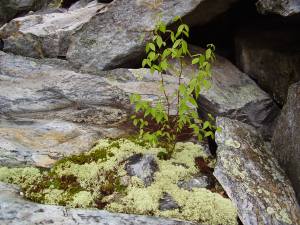
Probably well before that 1979 copyright, I must have learned about the origins of soil in school. But I honestly haven’t thought much about it since—how soil is basically weathered and eroded rock, mixed in with what plants and animals contribute. Lots of things work on the rock, which is so misunderstood as an immutable object—it’s changed by wind and rain, plants, and the acid secreted by lichens (which are actually algae and fungi working together). When lichens die, they disintegrate and mix with tiny rock fragments, and the resulting little patch of dust nestled in a tiny crack can be the perfect home for a new plant. On and on it goes until there’s more plant than rock.

Trying to watch the process would be eons longer than watching paint dry, but I appreciate that it’s happening in slo mo, with that verdigris color, that patina so many lichens sport a fitting hue for such a worthy vintage endeavor.

John Muir had a way of getting at the interconnectedness that sometimes a good nature book, and often a long walk, can convey. In My First Summer in the Sierra, he wrote:

Everything is flowing — going somewhere, animals and so-called lifeless rocks as well as water. Thus the snow flows fast or slow in grand beauty-making glaciers and avalanches; the air in majestic floods carrying minerals, plant leaves, seeds, spores, with streams of music and fragrance; water streams carrying rocks… While the stars go streaming through space pulsed on and on forever like blood…in Nature’s warm heart.

PS: I’m adding a new link here on the site to Mile…Mile & A Half, a movie about a hike along the John Muir trail. It’s a real cinematic treat for anyone who loves to walk, loves nature, and especially for those who hope to hit a long trail with a serious backpack someday.

The Call of Pick Your Own

We have an orchard within a long walk from our house. We’ve never walked to it, though, because how could we leave there without carting an abundance: bushels of apples, jugs of cider, prizes from the farm stand? Our haul wouldn’t mix well with the busy road and its narrow shoulder, although I still consider the adventure from time to time.

It was at this orchard, only a few years ago, that I first saw a pear tree. I was taken by its golden aura in the early autumn sunlight. Every year they put out a PYO (pick your own) sign when the berries come in, and somehow I never make it there—in fact, I don’t recall ever picking berries from a patch. This year, I am determined to make it to blueberry harvest and emerge, stained purple, happy, and ready for a pie.

I’ve been reading about harvests lately, a venture that goes so well with the spilling proliferation of summer, vines and stems laden with promise.

Anne Porter (who was artist Fairfield Porter’s wife) captures that spilling over in her poem The Pear Tree—here are the last two stanzas:

And every blossom
Is flinging itself open
Wide open

Disclosing every tender filament
Sticky with nectar
Beaded with black pollen.

In Early Spring, ecologist Amy Seidl mixes her scientific knowledge about climate change with her love (and worry) for her Vermont surroundings. Her words about berries make me want to garden ambitiously, perhaps even with an orchard in mind:

 …I walk the acre as if it were a hundred, planning the geometry for my fruit tree grid. I envision apple, pear, and plum, and of course the hardy Reliance peach. And in as many places as possible, berries: currant, gooseberry, blackberry, raspberry, and blueberry. The list of varieties reads like a children’s fairy tale, a version of “Hansel and Gretel” where visitors stumble across an Eden dripping in fruit rather than a cottage dripping in frosting. It is very much a gardener’s fantasy, one founded in the belief that life is abundant and the role of humans is to work with nature to manifest more abundance.

This triggered a memory of my own attempt to capture an orchard on a page, actually a specific, memorable day when Gavin was still quite young and  first learned to love apples:

Orchard Day

Miles of trees, Macoun, McIntosh, Empire
and then the illuminated pears

The perfect gild and form
made him lean from the wagon
grabbing for fruit

At home we leaned down together to core it all,
heard the breaking skin, split and crunch, squirt of juice

How solemnly he sought and sorted the seeds,
big plans to plant our own grove just outside

It was a little cold that day–didn’t know the right depth or soil or way to tend

Should have planted them anyway.

Plugging in at Sunrise

Impression, Sunrise by Claude Monet

Impression, Sunrise by Claude Monet

I noticed that a lobby area at Wesleyan University has charging stations, where students can restore their iPads or phones to full buzz. And yesterday, our teenage guest needed our network login code, our specialized charger cord, our outlet.

I’ve been thinking about another, deeper way to charge. It’s 5AM, and my own smartphone tells me that sunrise is at 5:22. But the birds have been gearing up for dawn over this last hour. When I hear their predawn symphony its reminds me of the angels on the beach in the movie City of Angels–they are watching, waiting for the first burst of light, tuning in to a profound and mysterious message that’s not spelled out in the dialogue (warning: the bare posterior of Dennis Franz at the end of this clip is not quite as profound, but then again this part of the scene makes its own point about immersion in what matters).

It’s a personal anniversary for me—a year and a day since I started my book about what nature has to teach us. I’m not the first—there are big shoes to fill in this department, and come to think of it I’d be happy just to pick up the trail with my much smaller footprint. Take, for example, Diane Ackerman, who does her own “singing” about sunrise in  Dawn Light: Dancing with Cranes and Other Ways to Start the Day. Here she appreciates impressionist Monet as a “sensate”—someone acutely tuned into the gifts of the world:

Monet simply proclaimed, and adored, what we all experience from moment to moment: the wash of sensations that greet us on waking, and which we try, at our cost, to dismiss as wasteful, self-indulgent, unproductive, or by some other term designed to separate us from our true self. The freedom of unbridling that self and losing it in nature is immeasurable. Alive moments can be anytime, anywhere. If I closely watch any natural wonder, really watch it, nonjudgmentally, in the present moment, noting its nuances, how it looks in changing light, or on different days, yet remains recognizably the same, then the world becomes dearer and less trying, and priorities rearrange themselves with an almost audible clicking. 


Can you hear it too—that whisper of a click? Its message to me is to hit “save” and get out into the birdsong.


Look Down

moth

The foolish man seeks happiness in the distance; the wise grows it under his feet.
James Oppenheim

It’s become a bit of a cliché that people don’t look up enough; they don’t take the time to gaze up at the clouds, the stars, the echelons (you know, that V pattern!) of migratory birds.

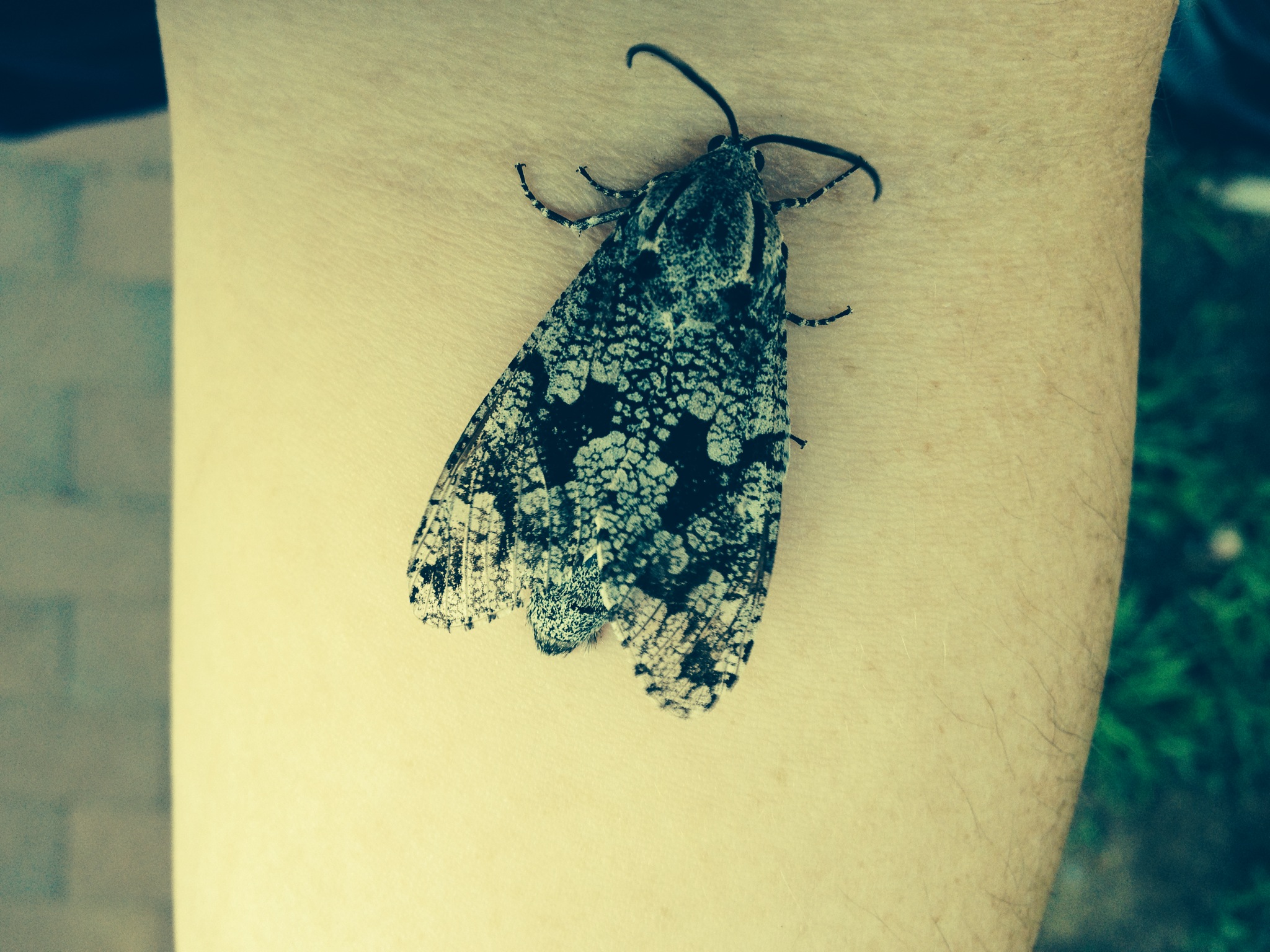
But what about looking down? My recent early morning walks have yielded foot-level sightings of rabbit families, colonies of funnel web spiders, a scurrying vole, entire condo complexes of ants, and a visit with a stunningly decorated moth in the center of the brick sidewalk. The pattern she boasted was reminiscent of some of the fine, filigreed, turn-of-the-last-century marcasite you can find at estate jewelry counters. My Golden Guide told me she was a caterpillarworm moth. They are known to lay their eggs near wounds in tree bark. My find, if she is lucky, will live three or four years. I think I increased her odds by removing her from the flow of foot traffic.

Of course,  my casual observations don’t hold a candle to those devoted to looking down, probably at the risk of getting stuck in a stooped position. EO Wilson, Pulitzer prize winner known to many as “the ant man”, can’t stop waxing enthusiastic about his favored species and his newer, inspired project, the Encyclopedia of Life. In The Forest Unseen, David George Haskell spent a year observing all manner of tiny life in a meter-wide mandala. And a chapter in Alexandra Horowitz’ On Looking is devoted to “Flipping Things Over”, in which field naturalist Charley Eiseman is a vigilant and enthused observer of insect (and other small creature) signs—tiny larval trails in a leaf, slug teeth marks, and such. This is the kind of guy who spends five hours in a driveway turning over leafs and logs before setting out on the “official” invertebrate tour he’s planned.

Those of us of a certain age, especially, will hear Casey Kasem’s voice in our heads when we read the quotation: “Keep your feet on the ground, and keep reaching for the stars.”It’s a phrase associated with American Top 40, but I think it’s okay to adopt it for much quieter time outside in nature, too. There’s a lot to see curbside, right alongside your sneakered feet.

Happy stooping!


Trail Magic

I haven’t made it up or down the Appalachian or Pacific Crest Trails yet, just short arms of the former and books about the latter. Cheryl Strayed can take the credit for making the PCT wildly famous with Wild, but before that I enjoyed A Blistered Kind of Love, about a couple who made the same journeya true test of togetherness that’s definitely something to crow about. Before that, of course, there was Bill Bryson, with his A Walk in the Woods on the Appalachian. And then there are the ancient trails across the sea. Joyce Rupp told the tale of her pilgrimage walk along the Camino de Santiago  with a quiet and strong voice in Walk in a Relaxed Manner. The list goes on ad infinitum.

It’s not clear anymore where I first read about trail magic–the trail in my mind is littered with books. But the author who introduced me to the magic so joyfully and vividly described stumbling on a cache of cold beer in a stream that I wanted some. And I hate beer.

Lucky for me, trail magic isn’t limited to just suds. The term is most often used to describe a small gift left behind by a fellow wayfarer, someone who knew you’d come along and appreciate the gesture amid the requisite sweat, blisters, and bug bites of a long journey on foot. But it can also simply indicate an unexpected joy on the path.

I almost missed my own trail magic today. I only had 20 minutes between summer camp drop-off and my work commute to walk around the bend of Cedar Lake in Chester, but I was quickly rewarded with the honor of depositing a wayward baby turtle back up onto the lakeside grass. Not long after that an unusually large (extended?) family of geese made a little parade across the street and down the bank. I walked by a slightly derelict French farmhouse-type house for sale, full of fantasy about the writing retreats I could host there, complete with forays to the water. Finally, I visited a unique gravestone at the tiny West End cemetery, painstakingly encrusted with colored stones. I waded through the damp grass and spoke to the soul honored there, reminding her that she must have been very much loved–and such a spot those who loved her chose! Across the  lake from the grave, summer camp was in full swing with hoots of happy children and bustling counselors. Trail magic, just from rounding the bend. Imagine what could happen with a whole coast!


Inchworms, Beach Worms, and Darwin

The best days are those that allow a long, thoughtful ramble in the warm summer air, but real life doesn’t always allow for such physical and mental perambulations. Today, I am settling for mostly “armchair” naturalist excursions—I grabbed what nature books I could stuff into my work bag, knowing I’d have a little interval between errands to flip through them.

Try this some time–pick up 3 random books on a subject you love and see if you can not find something in each that delights. For me, the first pick was a Golden Guide, not much bigger than my outstretched hand, to Butterflies and Moths. How many years have I been using the term “inchworm”–during my own childhood and later during countless forays into nature with children I taught or babysat, and eventually including my own child? Only today did I learn the more formal term: it is “geometer”—translating to “earth measurer”. And what knower of inchworms and lover of discovery couldn’t cherish the specifics of these descriptions: “UNADORNED CARPET is commonly seen in the larval stage in nests of wild cherry leaves…CURRANT SPANWORM is a pest of currant and gooseberry.” Who could begrudge these earth measurers their fine, colorful, and fruity choices, even if they do turn out to be pests to the farmer and gardener?

I chuckled at the silliness and synchronicity that greeted me when I randomly flipped the next book open: The top of page 51 in The Outer Lands, a natural history guide to local New York and lower New England coasts, told me that “Worms Can Be Beautiful” when “viewed without prejudice,” further flattering the reader by adding “they are only lowly when compared to the readers of this book, but their bodies and behavior are admirably adapted to the tidal world in which they live.” The author extols the iridescence of the clam worm, the castings of the lugworm, and the parchment worm’s homey residential tube. Would that I had a shovel and another hour and I’d be out on a nearby beach in Old Lyme, worming.

It was the comic book version that finally got me to read, at least in some approximate way, Darwin’s On the Origin of Species. This was the third and final book I got to peruse over coffee, and was a fitting followup to all of the gushing over the marvelousness of worms. I’ve never understood why some feel that a belief in evolution must negate a belief in God–couldn’t a higher power have caused it all to happen? I’m no expert on Darwin or creationism, but phrases like these lead me to think that Darwin had faith in something more than the increasingly upright ape (in the comic book, these words fall below colorful depictions of skeletons alongside full-fleshed animals–the scaffolds and the engineered marvels they support):

Can we wonder then, that Nature’s productions should be far ‘truer’ in character than man’s productions; that they should be infinitely better adapted to the most complex conditions of life, and should plainly bear the stamp of far higher workmanship?

Playing Hooky: A Crucial Nature Skill

I’ve set my sights on a day off alone before the long days of summer disappear.  I have a particular locale in mind, at least for a good part of the day. Fountain Hill Cemetery right here in town boasts a small but lively manmade pondone we have walked to after many school days to hunt for tadpoles and frogs. If we’re lucky, we see the rare heron, coyote, or fox. It’s no wilderness, and some might say a cemetery is an odd choice for spending time, at least before your time has come. But I like my nature mixed with history sometimes, and don’t feel any distaste for the residents who share the spacehopefully they have some knowledge that they are surrounded by beauty.

Our visits to the pond have always been times between–after school drop off and before work I have had walks there alone among the grassy hills , and strolls there after school have been limited by homework and dinner deadlines. On my last visit, I found myself wishing I could just sit quietly and watch the pond, and then sit quietly and watch some more.

I picked up an old favorite today–Flat Rock Journal by Ken Carey.  My timing was only a little off–just past summer solstice here and what I read was about an April or May tradition he and his wife kept. They’d each get a chance to “throw a few things in a backpack and set out to enjoy a day in the forest…Appreciation of the natural world draws out a self within us that knows what we, in our busyness, often forget.” His words that follow have me recognizing the urgent need for this kind of day:

I remember things in the forest, things I never intended to forget. Things that, as a child, I would not have believed could be forgotten. Johnny, our four-year-old, sometimes tells me of having seen faces in doorknobs or hearing voices among the trees–as if he senses some dimension within and behind what is culturally seen, an alam al mithal, as the Sufis say, where awareness saturates every particle, and beings inhabit all things.

Outdoors, immersed in nature’s season of renewal, there are moments, I find, when such perception comes. Moments when my awareness recognizes itself in all I see, and every pebble and leaf and tree looks back at me, mirroring some facet of myself.

When I feel I have been too long without this awareness, I know it is time once more to strike out alone into the forest, to experience a day among animals, trees, and open sky.

Sick of Nature?

What could be better than trolling the asymmetrical paths, piles, and aisles at Niantic Book Barn, eyes peeled for the next great nature read? David Gessner’s essay anthology Sick of Nature certainly caught my attention and its contrariness made me grin. I love well-written books on nature but have always had a love-hate relationship with Thoreau and his perfectionist, purist streak (see Ignoring Walden in the Get Satisfied book!).

How refreshing it was to read Gessner’s title essay, which begins by describing how sick the writer is of trees, birds, and the ocean, and of “writing essays praised as ‘quiet’ by quiet magazines”. He talks about how nature writing can be akin to church or Sunday School—either worshipful or preachy—and about how a kegger party with nature writers would probably go over like a lead balloon, although Thoreau and he might end up BSing late into the evening (if Thoreau’s drink was spiked).

After his rant–after all who wants to be boxed up in a genre?–he comes clean and admits to thoroughly savoring a memory of October on Cape Cod. (AHA, I knew he couldn’t turn away for long, considering all of the top-notch writing he’s done about the earth):

A month when the tourists finally packed up and cleared out for good. A month when the full moon rose over the pink-blue pastel of the harbor sunset and the blue-grey juniper berries shone with iridescence at dusk, and when masses of speckle-bellied starlings filled the trees (and the air with their squeaky-wheeled sounds). A month when the ocean vacillated between the foreboding slate grey of November and a summery, almost tropical blue (while occasionally hinting at its darker winter shades).  Most of all, a month of color, a month when the entire neck caught fire in a hundred shades of red.

Why Nature Writing? Why Nature Reading?

The intensive reading and writing required by my writing conference meant forgoing my long walks. My knees were stiff from disuse, and my soul craved the variety, stimulation, comfort, and sense of spirit that sojourns in nature bring. I slipped a book from my nature library into my bag, escaping into some fine turns of phrase for a few minutes. From where does the impulse to read and write nature rise? To me, it’s a sort of meditation–not just a good proxy for the actual experience, but a wholly necessary act of reflection and appreciation. Barbara Hurd, in Stirring the Mud, gets at what’s behind our literal connection with the earth, and how words can bring us closer to it, with compelling gusto:

When the German poet Rilke tells us to leave our houses and enter the enormous space outside, surely what he means is to follow the asterisk to the bottom of the page, to drop to our knees in algae, push hands into the fringed and seepy edges into which pieces of our lives have sunk, places where year after year the crust grows thin, too thin, finally, to mask the sense that underneath this unkempt border something else is breathing; the origins of our words, wiser afterthoughts, the whispered asides of the spirit.

Faith in Nature

At a writer’s conference yesterday, a new friend and I drove by the local sangha and she asked if I was Buddhist. I found myself not quite sure of what label to assign–I treasure many Buddhist tenets but grew up in, and have enjoyed, more traditional American church environs.

I thought of Emily Dickinson, and how much l’d enjoy staying home from church or sangha with her (that is, assuming she’d permit the company). Her take always resonates with me, more than most hymns or chants:

Some keep the Sabbath going to Church –
I keep it, staying at Home –
With a Bobolink for a Chorister –
And an Orchard, for a Dome –

The center of The Path by Chet Raymo is his 1-mile walking commute to his professorial post in North Easton, Massachusetts, a mere 2 hours from where Emily made her home. He, too, writes about the holiness found in nature:…”Why should we care about angels when the season’s first blackbirds spread their red-shouldered wings? Why should we seek treasures in Heaven when year after year the fiddlehead ferns unfurl their silver croziers along the brook?” 

For those of us with stronger ties to church, the hymn This is My Father’s World–inspired by a walk in Lockport, New York, brings together worship and nature:

This is my Father’s world, and to my listening ears
All nature sings, and round me rings the music of the spheres.
This is my Father’s world: I rest me in the thought
Of rocks and trees, of skies and seas;
His hand the wonders wrought.