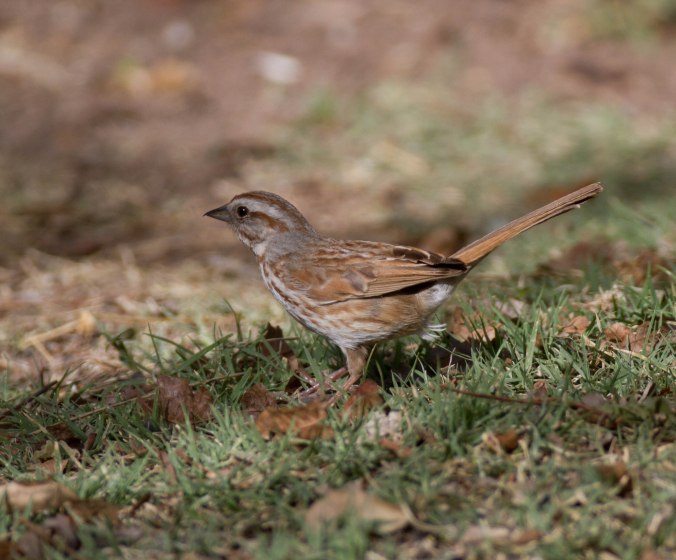
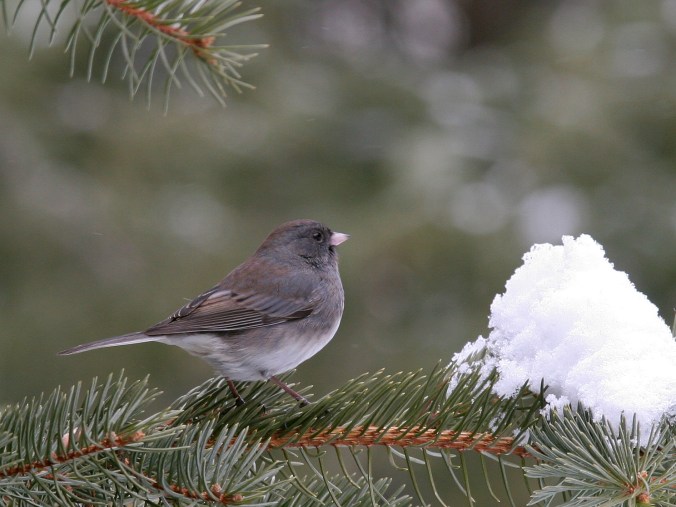
Song Sparrow courtesy of Budgora on Flickr
Last winter, I succeeded in becoming a bit hardier for winter walking, with the help of long johns and other snug layers. I learned that, despite the instinct to avoid the cold, there are long, interesting walks to be had on all but the chilliest and snowiest of days. With caution, of course. I had 2 friends who injured their arms by slipping on the ice; they, too, had been determined to get outside no matter what!
In a minor ironic twist, now I am prepared to layer up and get out but I am not supposed to bear weight on my foot. I am impatient about this, but yet again relearning the old lesson that there is something to notice, something to see when I get in the mindset to find it. The suet hosts the occasional Downy Woodpecker but it has been mostly quiet. What, then, is that hint of a movement on the ground below the feeder? Only with my binoculars can I discern a duo of song sparrows, who blend in so well with the dark leaf litter. They are hopping about, sporting those handsome striped heads.
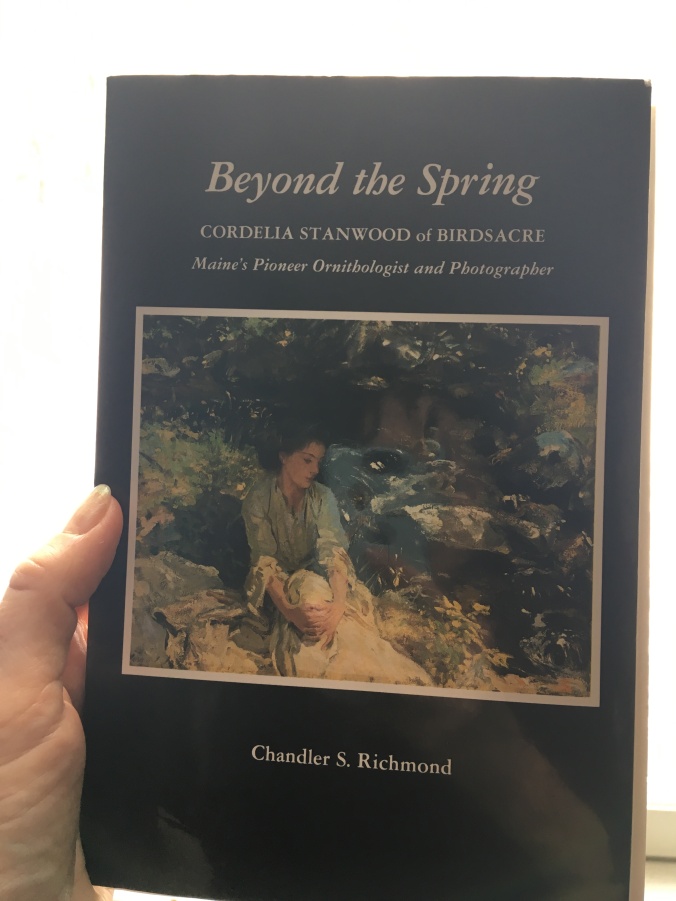
I watch Gavin walk back into the woods with envy and turn towards my new friend Cordelia. Well, the book about her, anyway. I bought Beyond the Spring during our family visit to Birdsacre in Ellsworth, Maine, this summer. Cordelia Stanwood isn’t exactly a household name, but I am so glad to be learning about this kindred spirit who died at 93, about a decade before I was born. The first 40 years or so of her life were typical for a single woman of her time who had the support of family and some resources at her disposal. She spent many years teaching and continuing her schooling. That is, until her nervous breakdown. She was back home with her parents and brother after this, and it sounds like for a while she lived a rather numb existence.
Her biographer, who based much of what he wrote on the voluminous papers she left behind, wrote about how she reunited with the world after her illness:
…One day while looking down the long hill below the house she had become aware of the rugged peacefulness of what she saw: the flat smoothness of snow-covered fields on either side of Card’s Brook, the lazy blue smoke curling up from the chimneys in town, the purple outline of the hills in Dedham silhouetted against the rosy tints of late-afternoon sky. Suddenly she felt as if a great weight had been lifted from her shoulders, and when a gull sailed majestically through the golden rays of late sunshine she had smiled and whispered to herself, “Oh, world, you are there after all. You haven’t changed. It is I who have been away, and you have been waiting for me all the time.”
Cordelia repaid the waiting natural world with countless hours of watching its birds and taking their photos. Today, you can visit Birdsacre and read some of Cordelia’s words as you walk the trails:
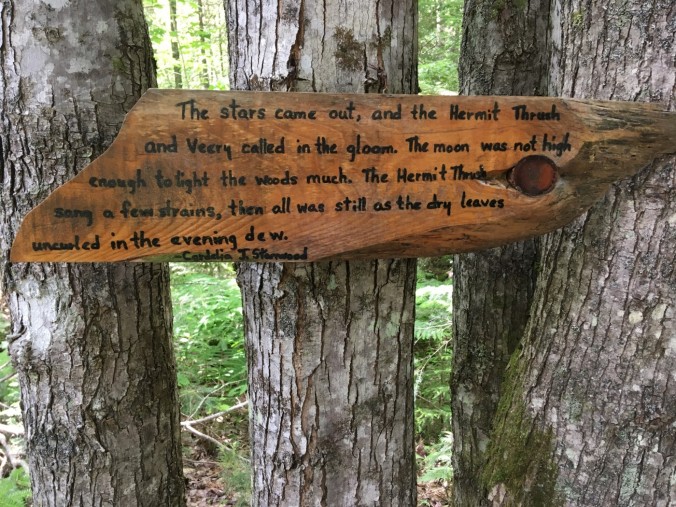
From Cordelia’s papers
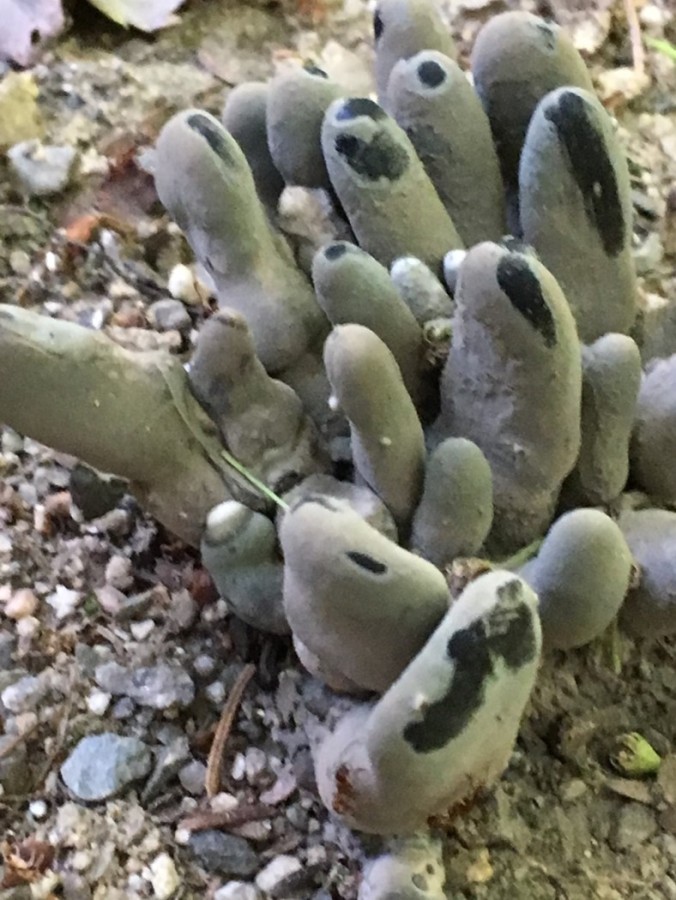
You can visit the injured birds that are referred to as “permanent guests” there. In the Nature Center, I was especially taken with the Merrit Fitch egg collection (more than 58 species of birds’ eggs collected by two teenage boys in 1888). AND with the dead man’s fingers that grew near the fence. They were the pièce de résistance of the pathway back to the car!
During these quiet, snowy days, I like to think back and imagine Cordelia’s reawakening to nature as she looked out over the snow. I like to think about how this possibility is there for us every single day. I have many times felt that recognition, that delight as I looked at a bug or a leaf or a bird—that deep knowing, as Cordelia did, that the world is always waiting for us. We just need to rise up to meet it.

 The day could have been one of near-panic. Despite a decade of efforts to simplify Christmas, each year it still boils down to many items piled onto my already overflowing to-do list. Even tasks that carry genuine meaning for me – like creating a photo card that will celebrate our treasured son and reach out to friends old and new – threaten to sap my time and energy. It’s a matter of simple math—more to do, but no extra time to do it.
 I looked up at the bare trees as I walked, taking in long-abandoned birds’ nests now exposed and trying to remember what squirrels’ nests are called (dreys!). I examined the varied barks of this tree and that—some smooth, some wrinkled, some like alligator skin. I felt appreciation for older, craggy trees that are allowed to age with dignity and must be homes to many a grateful creature. For the gazillionth time I wondered if I might look up and see a sleeping owl in some tree hollow or on some high branch (it hasn’t happened yet but I keep hoping). I remembered reading about how some trees hang onto their seed pods all winter, poised for the chance to drop them into the soft, fertile spring soil.
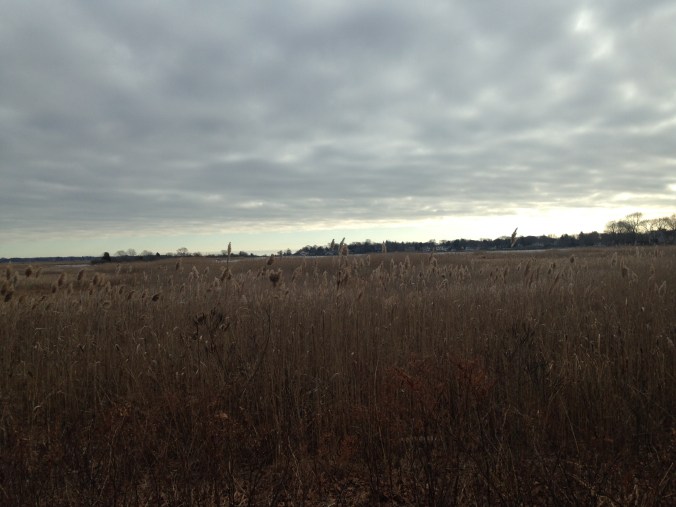 The marsh came into full view as I strolled, and I simply stood there watching it for a while. I admired the fat, feathery cat tails swaying in the wind. I saw some sparrows or juncoes darting about.
 In the meantime, the cold doesn’t seem so very harsh any more. It was a Christmas gift tailor-made for me—this moment of being reminded that simply stepping out, simply stopping to gaze and wonder, even in the harsh cold, even shoehorned in between the gazillion waiting tasks, can reveal a world that’s been waiting patiently all along. The bench placed there by a local church seemed to be placed there as a fitting caption:


 First Person Naturalist
