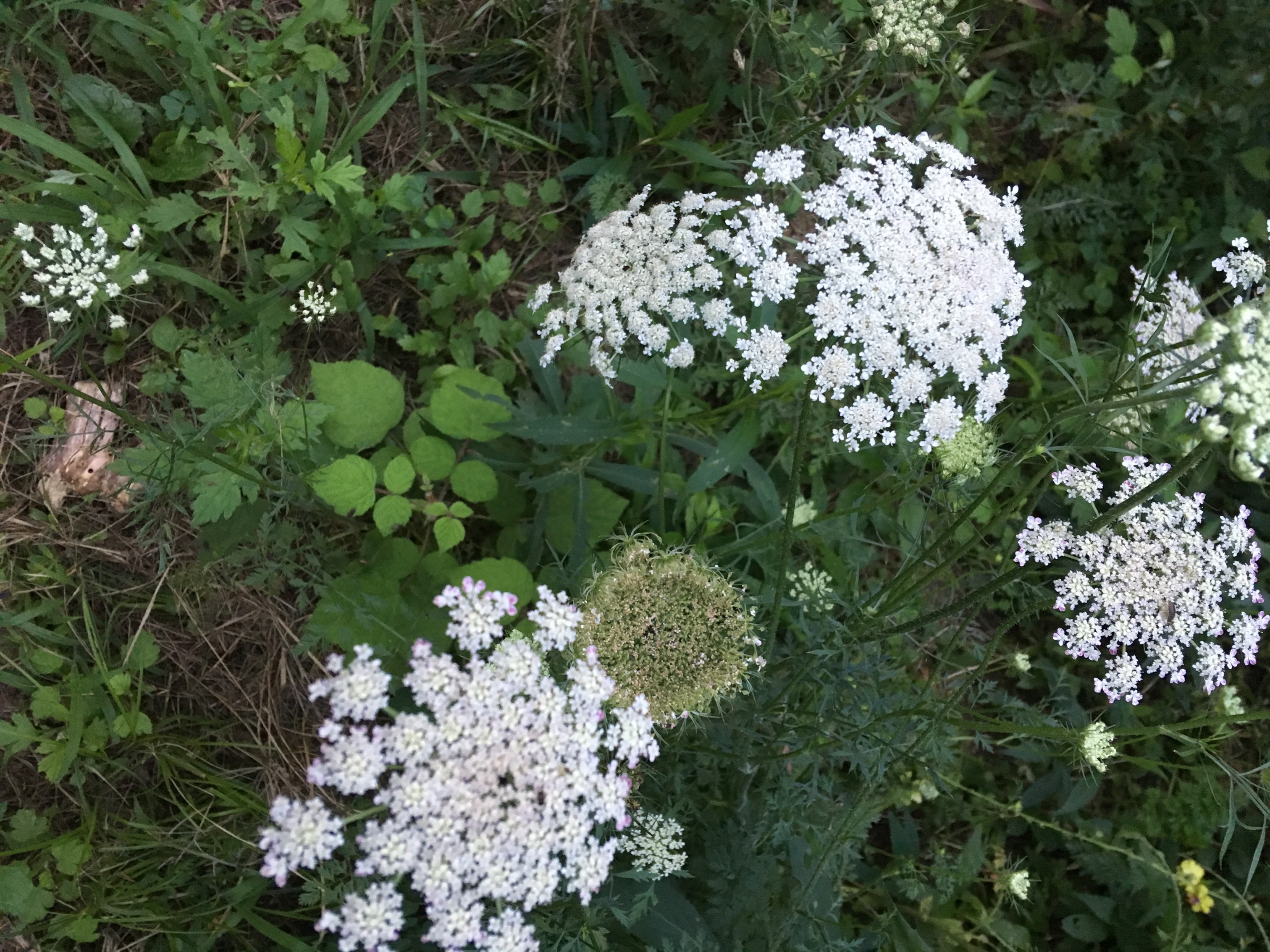
Lace in the meadow
This seems to be the peak of the year for Queen Anne’s lace. That economic principle of things being of less value when they are super-abundant doesn’t apply for me, when it comes to these leggy white blooms that greet me from even the most untended stretches of road. As a small child, their colloquial name captured my imagination—it was one of the first wildflowers I learned. Ediblewildfood.com recounts the legend of Queen Anne of England (1665-1714) pricking her finger, thus the “drop of blood” that shows up on the flower as a tiny purple dot, when you look closely.

Closeup of the purple “blood” on the flower
As with most familiar plants, this one has many names. iNaturalist.com (a great app, if you have a smart phone especially, for learning about flora and fauna) told me that my photo was of a wild carrot, or Daucus carota. I was delighted to learn of other colloquial names, too: bishop’s lace and bird’s nest.
I became preoccupied with the desire to know why, in the morning, some of the flowers have curled in on themselves – and they do look like birds’ nests – or the loveliest version of a tiny cage. I wondered if they all curl up at night, and then for some reason open at different rates in the morning. But the World Carrot Museum site tells me that the umbels (or seed heads) curl inward once they are spent, and the hooked spines that cover the fruits aid dispersal, since they can cling to the fur of animals. Aha! When the flowers are open, they allow pollination, and when closed, they have gone to seed and are ready to “go forth and multiply.” (aside: I was so tickled to learn that there is a World Carrot Museum, even if it is only in cyberspace).

The “bird’s nest” or cage, when the plant has gone to seed
My sister once had an awful experience of picking what she thought was Queen Anne’s lace and having an intense, photosensitive allergic reaction. She had found herself a bouquet of wild parsnips, not wild carrots, and apparently there is also poison hemlock, another look-alike to worry about, which lacks hairs on stems and leaves compared with the proper Queen Anne’s lace (note: I am NOT an expert—learning as I go!). While the wild carrot root is edible, if you get it at the right time, it is a very risky business unless you really know your stuff. Poison hemlock is so named for a very good, deadly reason, and wild parsnip, while ostensibly having an edible root, carries the risk of at least the aforementioned reaction. More info here, if you are curious about differentiating these plants (although I can’t guarantee the expertise of the video maker! Foraging experts say that the best way to learn, and be safe, is to go out foraging with a bona fide expert).
My appreciation of Queen Anne’s lace’s ubiquitous loveliness took a turn into a discussion of poison, which wasn’t what I planned. I may have gone off on this tangent because I am hoping to pursue my Master Naturalist certification in the spring, and am amazed and intimidated by how much there is to know! But there is also delight in learning, something I look forward to.
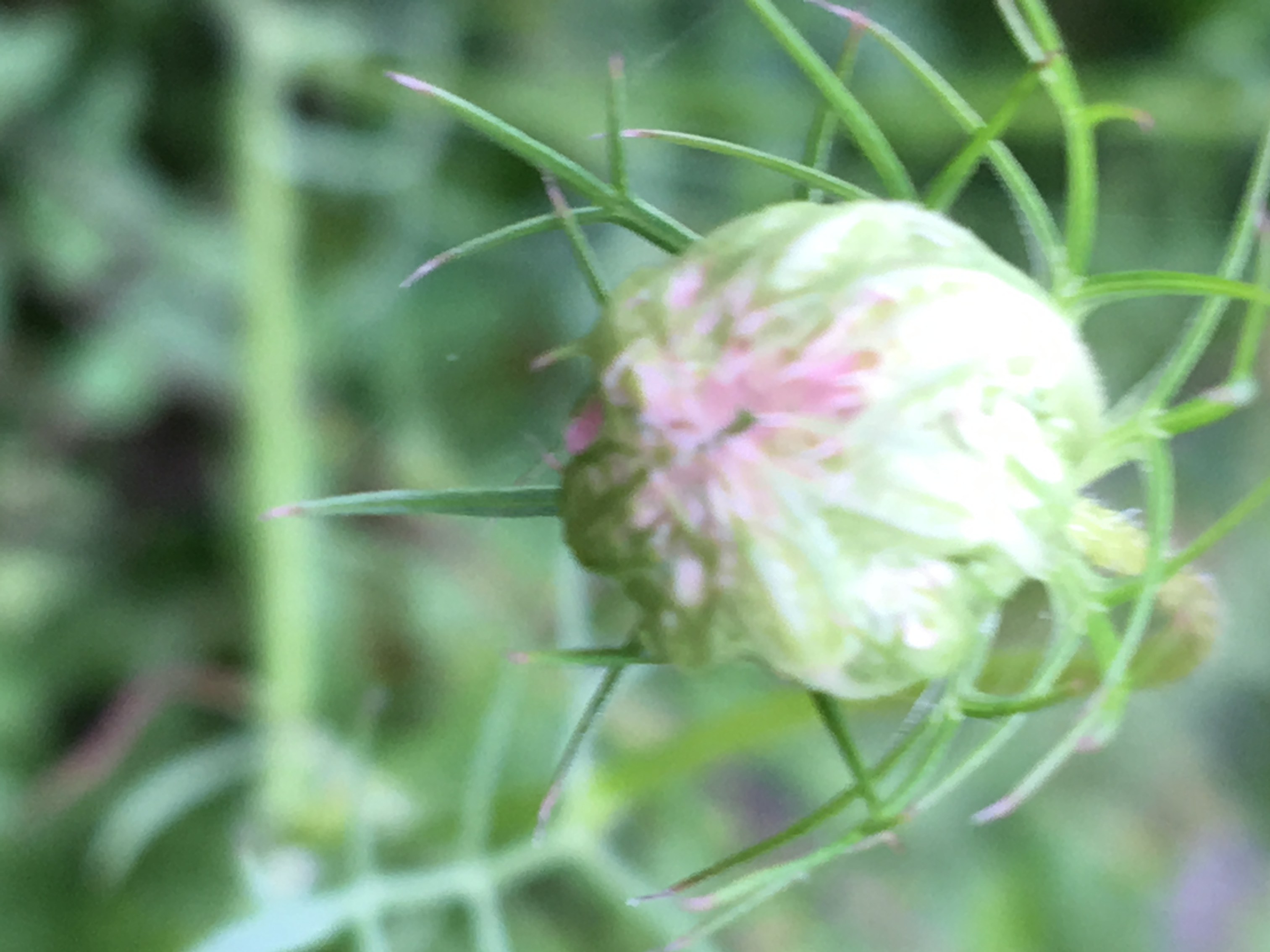
In the beginning…a new bud of lace
In the meantime there is simple appreciation, and for me there is always a balance to be struck. You can “know” the wildflowers and insects and animals that you meet as friends—appreciating unique qualities and observing them with alert senses. You can also “know” as an academician knows, even to the point where you are encyclopedic on the topic. Neither way is inherently bad, but too much of one risks obliterating the other. Knowing based on just your own observation can mean false assumptions, and limitations. Knowing based on simply facts can push aside the beauty of the thing. I wonder how much William Carlos Williams knew when he wrote about the seemingly single-minded effort of this plant?:
…until the whole field is a
white desire, empty, a single stem,
a cluster, flower by flower,
a pious wish to whiteness gone over—
or nothing.
(The poem is copyrighted; you can read the whole thing here).



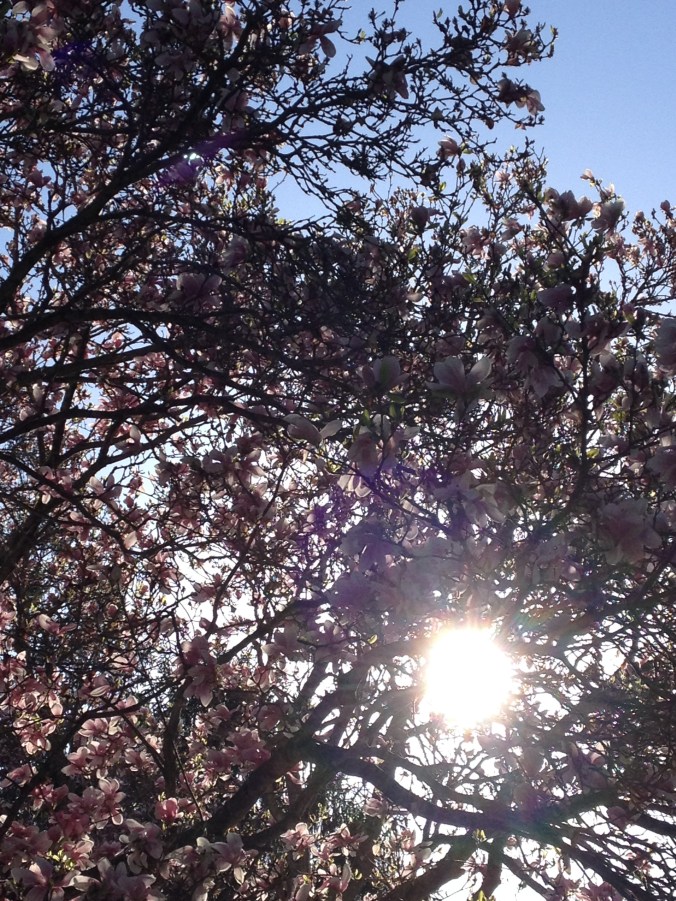


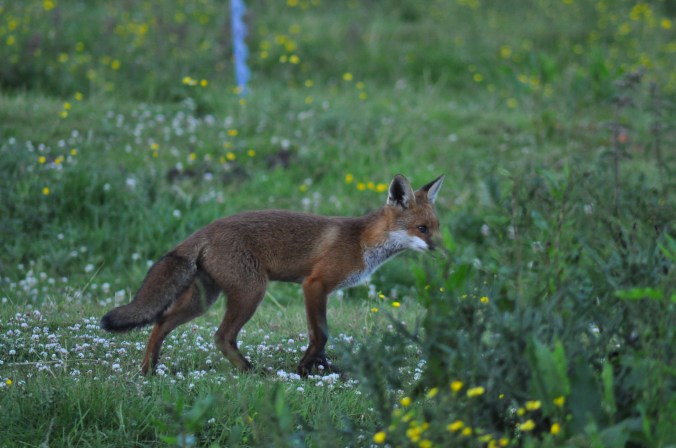


 The day could have been one of near-panic. Despite a decade of efforts to simplify Christmas, each year it still boils down to many items piled onto my already overflowing to-do list. Even tasks that carry genuine meaning for me – like creating a photo card that will celebrate our treasured son and reach out to friends old and new – threaten to sap my time and energy. It’s a matter of simple math—more to do, but no extra time to do it.
 I looked up at the bare trees as I walked, taking in long-abandoned birds’ nests now exposed and trying to remember what squirrels’ nests are called (dreys!). I examined the varied barks of this tree and that—some smooth, some wrinkled, some like alligator skin. I felt appreciation for older, craggy trees that are allowed to age with dignity and must be homes to many a grateful creature. For the gazillionth time I wondered if I might look up and see a sleeping owl in some tree hollow or on some high branch (it hasn’t happened yet but I keep hoping). I remembered reading about how some trees hang onto their seed pods all winter, poised for the chance to drop them into the soft, fertile spring soil.
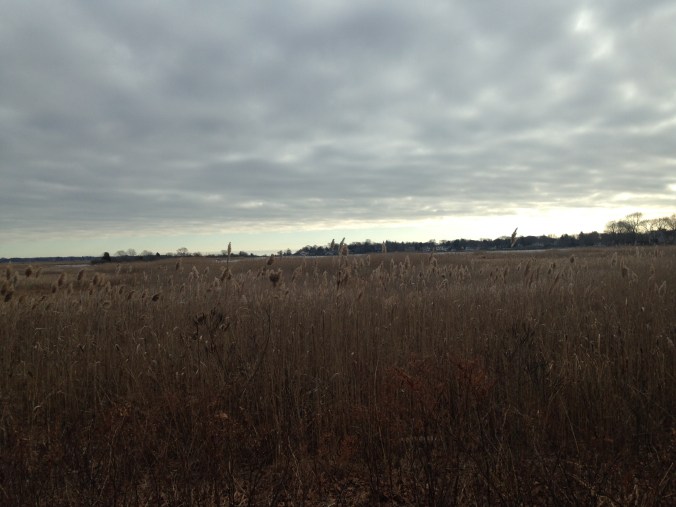 The marsh came into full view as I strolled, and I simply stood there watching it for a while. I admired the fat, feathery cat tails swaying in the wind. I saw some sparrows or juncoes darting about.
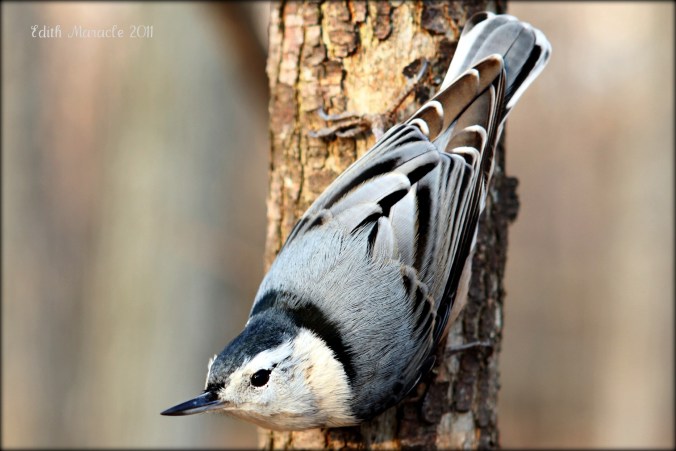
 In the meantime, the cold doesn’t seem so very harsh any more. It was a Christmas gift tailor-made for me—this moment of being reminded that simply stepping out, simply stopping to gaze and wonder, even in the harsh cold, even shoehorned in between the gazillion waiting tasks, can reveal a world that’s been waiting patiently all along. The bench placed there by a local church seemed to be placed there as a fitting caption:





 First Person Naturalist