The Book of Noticing

2016-05-01 08.32.39

Admirable tree in East Haddam

Soon, I want to write about tent caterpillars and robins and nests and the soul’s ease that comes with long walks during lengthening days…But this post is just a short one, because I want to share great news!

I just signed a contract to have The Book of Noticing: Collections and Connections on the Trail published by Homebound Publications. So, this time next year I expect to have the bound book ready for release into the world! There may be Kindle and audio editions, too!

The Book of Noticing is a contemplative narrative on time in nature and the deeper truths that the experience reveals. It takes in the variety and beauty of many adventures in New England, weaves in intriguing facts from the natural world, and often steps back to look at broader subjects like family, a meaningful life, and the future of our planet.

(That being said, I need friends to help me perfect a really good “elevator speech” that can help me encapsulate what this book is about! I have less than a year to learn how to be a good marketer, and any and all tips will be genuinely appreciated).

2016-05-07 08.17.51.jpg

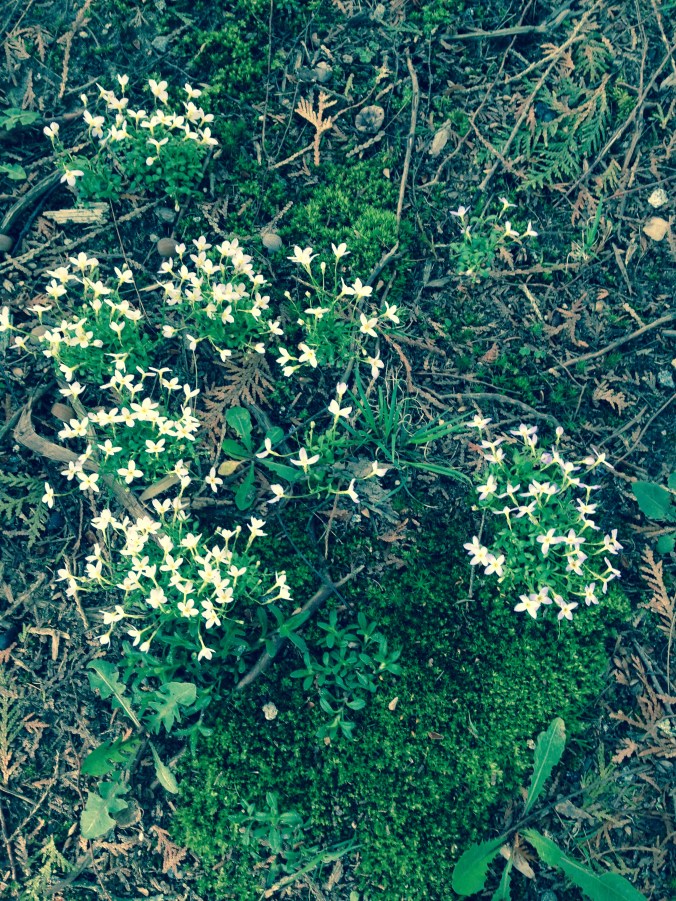
My neighbor on Bridge Street has been mowing around these beauties!

Hodgepodge Lodge, and Considering the Lillies

frogs

Since I can’t share my own hodgepodge of a collection firsthand, this blog is sprinkled with some Deep River wonders. These frogs live at Fountain Hill.

When I spout reminiscences about the Hodgepodge Lodge show to other people my age, I get a lot of blank looks. I guess I should be grateful my mom steered me over to PBS. Because the Lodge was a big influence during my formative years. If you’ve never been initiated here’s a clip from YouTube.

I have fond memories of the kindly woman who starred in the show and her many lessons in the ways of wildlife. Miss Jean was very pragmatic also, and sometimes the wildlife -while clearly appreciated -got eaten. For some reason, the episode I remember most is one about cooking food  (fish, I think) in a Dutch oven buried underground. I perceived the results as nothing less than magical. But most episodes didn’t center on cooking. I remember cocoons, frogs, caterpillars, kids with butterfly nets,  and a meadow. I researched the show and Miss Jean and the actual Lodge just now, and was touched to learn that the original Lodge, built to be a set for the show, was restored and moved to a nature conservancy in Maryland. It also seems that Miss Jean is still an active contributor to the nature scene (and I have just written her an email fan letter, nearly 40 years after the show went off the air!).

Over the last decade or two, I’ve been returning to my Hodgepodge Lodge roots, which harken back to the days when I still wore many hand-me-downs, blissfully unaware of how I looked or why that could ever matter. When I show up at local nature events—at places like Connecticut Audubon Society or The Stewart B McKinney National Wildlife Refuge or the Flanders Nature Center, I am garbed in attire that might be described as anti-fashion. Practical, comfortable shoes; layered clothes that can get dirty; something to cover my head should it rain; back pack stuffed  with more practical items. More and more often, binoculars dangle from my neck. I am nature nerd central. (Speaking of nature nerds, a fellow naturalist has a good blog named just that: Nature Nerd).

Aside for word nerd readers: the term hodgepodge “comes from hogpoch, alteration of hotchpotch (late 14c.) ‘a kind of stew,’ especially ‘one made with goose, herbs, spices, wine, and other ingredients’,” according to the Online Etymology Dictionary.

When I look around at my fellow nature lovers, they are – almost without exception – fashion challenged as well. But the appeal for me is in their alert eyes and interested expressions. They are asking questions, or peering into the water, or trying to recall something they read. Sometimes, an expression of amazement surfaces, with the sighting of a creature or a prized new fact learned. These are my adopted people.

Recently, I was part of a small gathering of Edwin Way Teale fans. We met at Trail Wood, the place where I had my writing residency this past summer, and shared our favorite passages from his work. We sat in a circle surrounded by inquisitive (but not biting) may flies, reading aloud and pausing to comment or look up at a bird or wonder aloud if we might spot the various species Teale recorded on the surrounding land. It was nice to think of Edwin and his wife Nellie having their many adventures on the nearby trails.

The information shed on the Trail Wood property has its own Hodgepodge Lodge type of accoutrements that come and go over time, like a wasp’s next or feathers or the white board where visitors can note the creatures they spotted that day. A side room houses some taxidermy, and curious visitors can also thumb through the musty guidebooks and other nature-themed reads shelved there.(See this CT Woodlands issue for mine and a fellow nature writer’s pieces on Teale and Trail Wood).

Teale cabin quote.jpg

This sign is inside the Teale cabin at Trail Wood. The glare obscures the attribution, but I believe it is from an old tombstone in England.


I relish collections like this; the more eclectic the better. In an older entry I wrote about one enviable cache kept by an archaeologist and cartographer. The original name for my book – Cabinet of Curiosity (recently submitted to an interested publisher, now with a different title!) – reflected the happy collecting of talismans from nature. And a great read from Vermont Quarterly that my sister put aside for me, about Bernd Heinrich, included snippets about what he’s accumulated in his rustic Maine cabin. His laptop sits amid a set of watercolors, field notes, field guides, etc, with hawk feathers and binoculars nearby and a whole tree trunk holding up the ceiling. I love this part of the article:

On the way out the door, I stop to photograph three items on the window ledge: a pair of desiccated spiders pinned to a block of foam; a pile of animal poop which includes a bird’s claw; and an embossed circular medal. “Those barn spiders had just laid their egg clutches,” he tells me later, and the scat was probably deposited by a coyote who had eaten a grouse. “I saved it to quiz the winter ecology students,” he explains. “They should be able to tell me the season too—because a piece of toe skin has fringes.” Heinrich makes no mention of the medal sitting next to the poop: it’s the John Burroughs Medal, the highest honor in American natural history writing.

I am sure Heinrich must have felt honored by the medal and that its proximity to scat is not a reflection of his thoughts on John Burroughs or his namesake award. But I also think that Heinrich has his priorities in order. He needs  to be outside, studying the denizens of the natural world. In his world, scat with a revealing history is just as important as accolades (and likely more so). I am guessing fashion isn’t high on his list, either. I would treasure the nature-centered hodgepodge in his cabin more than any decor or wardrobe that you could offer me.

Which brings to mind something I learned quite young, in Sunday School:

Consider the lilies, how they grow: they neither toil nor spin; but I tell you, not even Solomon in all his glory clothed himself like one of these. (Luke 12:27, NASB)
small white flowers

Somewhere along Bridge Street


Found nest

Spotted this nest today along the shore of one of the quarry ponds, near Plattwood Park


Timberdoodle versus Human: Which Singles Scene is More Exhausting?

American Woodcock

American Woodcock image courtesy of Paco Lyptic on Flickr

I don’t miss my single days—trying to look just right, the awkwardness of some conversations, disappointing dates, and being pursued by men who just seemed overeager.

Of course, that was a long time ago. And I don’t know for certain if it’s still the case that the men often take the lead—asking for a phone number, or a date, or trying to plan a “perfect” night. For all I know, the women are in complete control now! But, back in the day, I felt for these guys, with such an onus of needing to impress the girl.

Well, I’m here to argue that the American Woodcock (aka Timberdoodle or Bog Sucker) has a much more difficult time of it. For proof, if you are local, get to the Stewart B. McKinney Wildlife Refuge in Westbrook this Sunday for a repeat of this  past Saturday’s American Woodcock event—a brief talk and then watching the male do his elaborate courtship display.

Scientists or other exacting readers, please forgive me if this summary is less than 100% precise. But the male’s courtship job basically involves:

  • Calling out for quite some time (can you say PEENT?) while rotating in a 360-degree circle on the ground
  • Shooting up into the sky for an erratic (or maybe to the female, it’s erotic) flight while making strange whistling sounds with your feathers
  • Zooming back down while making another sound, described by some as “whimpering chirps” (is this desperation setting in?)
  • Landing in about the same spot, often to do it all over again (and again) (and again).

All of this is based on the assumption that there must be a female woodcock camouflaged in the brush, just waiting to meet you!

Here’s a good account, complete with audio, from Miracle of Nature.

If you can get to the local event, it is so worth it. It’s led by Patricia Laudano, president of the local Potopaug Audubon Society. She’s been developing her very specialized expertise in this species for many years! (If you don’t hail from Connecticut, it might be worth researching if there’s something like this going on in your area.)

It is a truly a treat to learn about these amazing creatures, their upside-down brains, and the labor-intensive ritual that makes human dating look like a cake walk!  Plus, to me they are uniquely enchanting. Bonus: they are an ungainly, endearing, persistent, and often unnoticed sign of spring!


Squirrel and Snow Flea Love: To Everything a Season

Last weekend again found Gavin and me at Trail Wood, where we did some very rudimentary tracking.

What delight it gave me to find deer hoof marks in the snow by Edwin Way Teale’s cabin:

deer hooves

Days before, I had snapped a photo of what I assumed must be rabbit tracks in the snow of our yard. But it turns out they belonged to the ubiquitous grey squirrel:

squirrel prints.jpg

I am starting to realize that the squirrel is relegated to “only” statements unfairly. Why only a squirrel? They have whole, busy lives that go mostly unnoticed right outside our door–gathering food, meeting friends and “significant others,” avoiding predators (and in our case for many years past, chewing their way into cozy attics).

Did you know it is the first of two yearly squirrel mating seasons? Consider this when you are vexed by these bullies of the birdfeeder–the next squirrel you see may be expecting!

I am sure that without Gavin I would never have spotted the snow fleas aka springtails by Teale’s cabin. All that hopping is because they don’t  use legs or wings to move—they are propelled by an abdominal appendage (thank you Backyard Almanac!). The fleas, too, are in or approaching mating season, which depends on relatively warmer temperatures.

snow fleas

Love abounds in the creature world, just in time for Valentine’s Day. How blessed we are when we slow down long enough to notice all of this amorous buzzing about in the snow! New life is not as far off as it seems. (PS: if you have somehow missed the famous Byrd’s pop/folk version of Ecclesiastes 3, see the original hereattribution to King Solomon makes this the pop song with the oldest lyrics). Beautiful poetry, and certainly rings true when you observe the cycles of the natural world.)

New Year’s Gift: For Nature Lovers and Writing Hopefuls

Last week’s entry was about the gift of a snail (well, a book about one, anyway), and my resulting fervent wish for snail love darts.

This week, I am offering a small gift (although not as small as a snail love dart). I’ve written some basic, beginning instruction on how to get started with nature writing, and a free PDF excerpt from the book is available on the Lessons in Nature Writing tab.  I’d appreciate it greatly if you would share the link!!

What You Can Do About Climate Change from The New York Times

A fellow nature/ecology writer posted this and it’s worth paying forward: a nice, succinct piece from the Times on what makes a difference in climate change.