The Squeaking is Real: Chipmunk Baby Boom

chipmunk-flickr-moschell

Courtesy of Mark Moschell on Flickr

So I haven’t imagined it!

I am not sure when I first noticed it—maybe June? Any walk in the woods, or even down many of our local streets, is peppered with frequent small squeaks followed by the sound of tiny feet skittering through the leaf bed to safety. Often, a chipmunk will run across the trail ahead of my approach, maybe 20 feet hence, tail high. Noticing chipmunks is, of course, not new. But this many? It turns out the favorable weather and food supply this year has led to a bumper crop, according to the DEEP.

Characteristically timid, these creatures can be bold when they want to. My neighbor Susan watched them eating her garden tomatoes. Maybe she was anthropomorphizing, but to her they seemed to be doing it with a sassy defiance in their eyes. They got one or two of my tomatoes, too—didn’t even bother to eat the whole fruit!

Various articles online warn about the potential for garden mayhem or even structural damage. But fears of a chipmunk home invasion don’t keep me up at night. Mostly, I just enjoy them. I assume the squeaks I hear as I walk are squeaks of alarm—a human is coming! Somehow, it amuses me that they would be so fearful—of me? I try to talk to them sometimes, putting on my most soothing voice. But they freeze, every muscle tense, ready to run frantically if I get any closer.(Here’s some audio of their sound repertoire, courtesy of WiIdlife of CT).

I call every chipmunk I’ve ever met Chippy. We have one or two Chippies that live within a stone’s throw of our front door. They seem to love to dart in and out of our stone walls, and I love the liquid black of their lively eyes, the defining stripe in their fur. But that, along with my recognition of their characteristic squeaks, has been the extent of my knowledge on these critters. I decided to learn more.

According to Live Science , chipmunks are the smallest member of the squirrel family. This makes sense—similar behaviors, similar characteristic stance, standing on two feet. But I hadn’t really thought about it before. There are 25 species in North America. Apparently they are pretty much loners, except during mating season, which happens once or twice yearly (late spring and fall).

chipmunk kiss sarowen.jpg

Courtesy of Sarowen on Flickr

Okay, here’s a quote from Live Science that really makes me want to see a baby chipmunk:“Pups are hairless, blind, pink creatures the size of a jelly bean.” Of course, those pups would be hard to spot, and it’s reported the mothers are very protective. I’d also like to see a chipmunk who’s just about met his capacity for filling cheeks with food—their cheeks can stretch to three times the size of their head!

Acorns seem to be their big thing, but they will eat nearly whatever they find, including baby birds and birds’ eggs. And this is useless information, perhaps, but I was quite pleased to learn that they possess very tiny thumbs.(Thanks for the factoid, Lakeside Nature Center!)

I think there could be copyright issues with picture reposting, but if you want to see some heart-melting photos of these creatures, check out National Geographic’s slide show here.

 

What I Learned About Sunapees on My Summer Vacation


My husband Tom found a new vacation place for us this year. We stayed at a just-the-right-size cabin (courtesy of Airbnb.com) in Freeville, New York. Freeville itself is quite the small town (population 523, part of the larger town of Dryden). Our cabin is adjacent to meadow and trails, and that has been a soothing delight overflowing with colorful mushrooms, dragonflies, and wildflowers. But as nature-loving as we are, we might not have chosen the area if it wasn’t also close to Ithaca, home of Cornell, complete with interesting college town, and, more importantly to me, some impressive waterfalls and gorges. Hence the “Ithaca is Gorges” T-shirts, bumper stickers, mugs, key chains…Great slogan if you are a pun appreciator!!

We were determined to swim in a local watering hole, perhaps one fed by a magnificent waterfall. The first swimming spot we tried, at Buttermilk Falls park, turned us away—no swimming that day. We guessed why when we got to the Robert H. Treman State Park,  which was supposed to look like this:

Robert H Treman promo


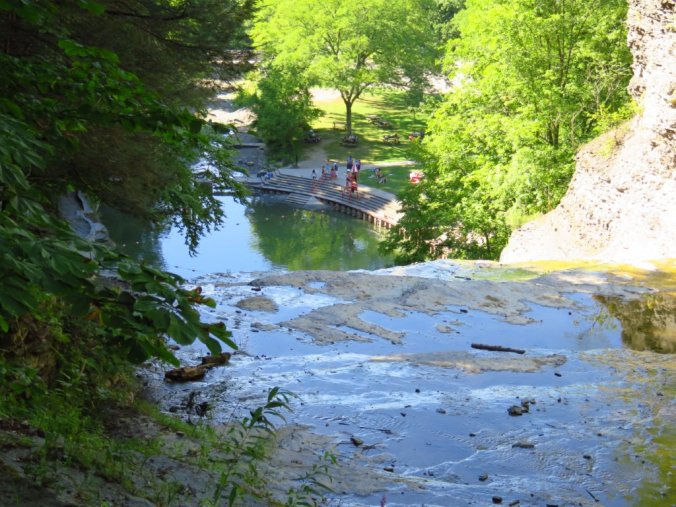
But actually looked like this:

Robert H Treman reality.jpg

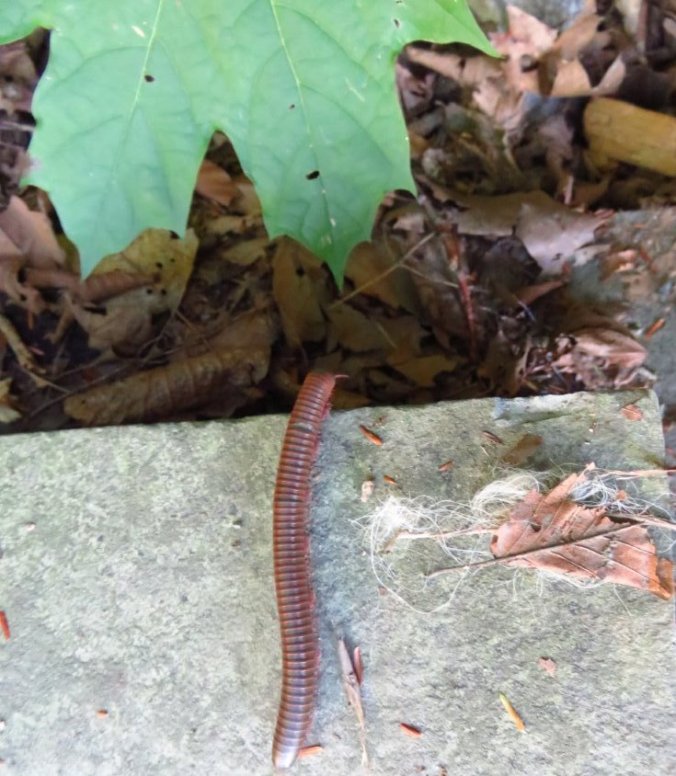
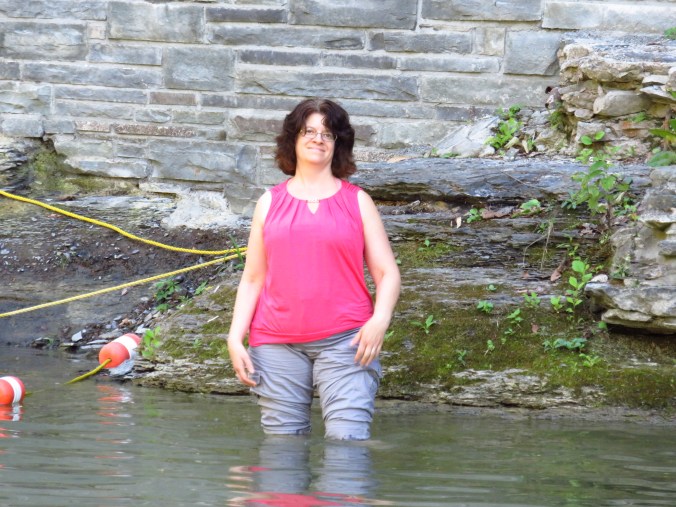
According to Ithaca.com, spring-to-summer months (March through June) were the driest on record this year. Hence the wade in the shallows that was not even worth a bathing suit. What really redeemed our disappointingly knee-high dip were the nearby children, maybe 3 years old, who started to shout, “We see a Sunapee! A SUNAPEE!). At first I thought they had found a sunny, one of those common fish so often brought in by a line. But then my mind caught up: a centipede! The little one confided that there were “sunapee babies, too,” although I only saw a large specimen, trying its best to blend into the rock wall as these high-pitched children made their enthused examination, crouching to peer closer, then again shouting SUNAPEE!! In happy unison.

millipede

Factually, a millipede. Forever remembered as a sunapee.

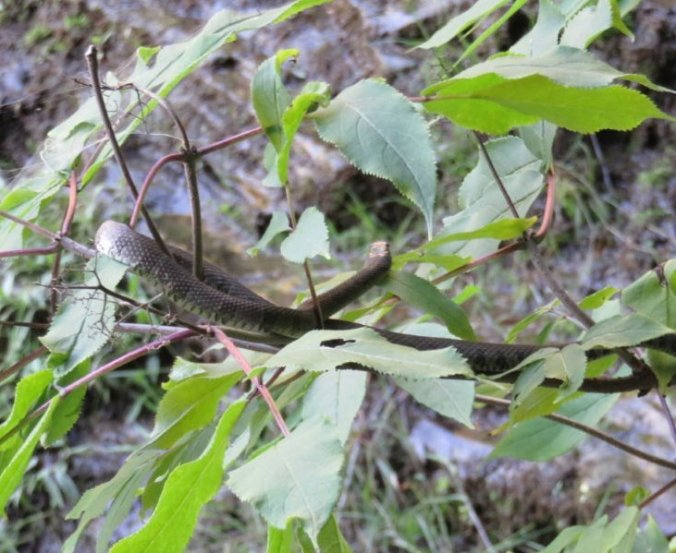
From there we took a short walk up the steps adjacent to the “falls” (or the spot where the falls should be). Maybe the kids helped us to tune in, because we delighted in a few more sightings: more millipedes (I only remembered the distinction later), an exotic-seeming caterpillar specimen, and a snake curled along a tree branch.

sycamore caterpillar

Fuzzy photo of a fuzzy caterpillar

tree snake

Gavin’s sharp eyes found this creature catching the breeze over the rocky ascent

I’m not sure about this—our photo was blurry, but a very impressive online identification site worth bookmarking  makes me wonder if we found the caterpillar of a sycamore tussock moth.

I’ve been reading Unseen City: The Majesty of Pigeons, The Discreet Charm of Snails & Other Wonders of the Urban Wilderness,  and it is the kind of book I wish I wrote. Then again, maybe I did! My upcoming Book of Noticing is all about tuning in and looking more closely at what is all around us. Mine is not urban, and its title is not as much of a whizbang. But I feel that author Nathanael Johnson could be a friend. He wants us to see and appreciate the squirrels, the pigeons, even the weeds, and it turns out they really are all quite interesting. There’s so much more to learn than we might appreciate at first glance.

For example, did you know that both male and female pigeons create a sort of super milk, one that has their young doubling their weight in a day?(No, pigeons do not have nipples, in case you were wondering. You’ve got to read the book to learn more!). The book has also inspired me to get my own hand lens to, as Johnson puts it, “peer into the Lilliputian realm.”

Large sheets of rain fell from the sky here in Freeville as I wrote this, and it fell when we hiked yesterday, too. This may mean bigger waterfalls for the next occupants of the cabin. Whatever the forecast, I hope that they also enjoy looking closely. There is so very much to see.

looking down at Treman park pool

The snake’s view

Galls: What Hides Within?

Gall 1 from flickr

Courtesy of Tom Hickmore on Flickr

This piece on galls was published quite some time ago, but it seems timely especially now, since I keep seeing galls!  

Have you ever noticed, among the nuts the squirrels have left behind on the lawn, small, peach-colored, fuzzy balls? How about pocked-looking, speckled spheres at the foot of the oak tree out in front? If you look, you’ll see many other assorted shapes and sizes, hanging off trees, clinging to leaves, scattered along the curb. Galls are everywhere, but most people know little about them.

Gall 2 from flickr.jpg

Courtesy of Arend on Flickr

Galls are growths formed by the reaction of a plant to mechanical irritations or chemicals produced by insects, bacteria, fungi, and viruses. Insect larvae live inside the protective shells of insect galls, growing to adulthood over the winter before emerging to the outside. Insect galls are generally more benign than the other varieties, some of which can cause ugly and sickly results for the plant.

There are more than 1500 types of insects in the United States that form galls. Wayne’s Word, an online natural history textbook by biology and botany professor Wayne P. Armstrong, describes the vast, and sometimes outlandish, variety of these phenomena: “Galls may be smooth, spiny or fuzzy, and resemble everything from marbles and ping-pong balls to dunce caps, saucers and sea urchins.” (See some of his intriguing photos here.)

Gall 3 from flickr

Courtesy of Picture Esk on Flickr

In 2007, gall wasps had a baby boom in southern Maine. Residents were perplexed by a sudden abundance of small, fuzzy balls in their yards. The wasps inside these spheres, not the stinging kind, emerged to procreate and die, leaving behind a new generation and a new crop of galls to protect the infants.

These tiny galls, commonly called “fuzzy oak” galls, are only one example of what insects and trees can do together. Oak galls as big as basketballs have also been reported. Willow trees can grow what appear to be “pine cones,” quite puzzling to passerby, which are actually galls caused by tiny gnats. Christmas trees may also sport “cones” that are not what they seem.

The benefit of galls to insects is obvious, but humans have also found ways to use these creations. Fisherman break open goldenrod galls to get to the tempting larvae bait. Tannic acid is a gall-derived product, and fine inks are also made from galls. Galls have also been used as a spice, (mostly in the Near East), and as food for livestock. A good tip for campers–dry galls make excellent tinder.

Once you start seeking galls, they “appear” everywhere. Wayne’s Word reported that almost every individual sand aster in one 50-acre grassland area in southern California had a swollen stem tip gall on it. It’s hard not to become a fan of these diverse creations, perhaps even more so if you get to see them “hatch”. You can bring them inside for viewing—be sure you provide a jar with some moisture—and see what (well, who) emerges.

The photos of galls below are my own–not the most beautiful or technically precise images, but literally home-grown!

Galls 2 Galls 1

The Book of Noticing

2016-05-01 08.32.39

Admirable tree in East Haddam

Soon, I want to write about tent caterpillars and robins and nests and the soul’s ease that comes with long walks during lengthening days…But this post is just a short one, because I want to share great news!

I just signed a contract to have The Book of Noticing: Collections and Connections on the Trail published by Homebound Publications. So, this time next year I expect to have the bound book ready for release into the world! There may be Kindle and audio editions, too!

The Book of Noticing is a contemplative narrative on time in nature and the deeper truths that the experience reveals. It takes in the variety and beauty of many adventures in New England, weaves in intriguing facts from the natural world, and often steps back to look at broader subjects like family, a meaningful life, and the future of our planet.

(That being said, I need friends to help me perfect a really good “elevator speech” that can help me encapsulate what this book is about! I have less than a year to learn how to be a good marketer, and any and all tips will be genuinely appreciated).

2016-05-07 08.17.51.jpg

My neighbor on Bridge Street has been mowing around these beauties!

Hodgepodge Lodge, and Considering the Lillies

frogs

Since I can’t share my own hodgepodge of a collection firsthand, this blog is sprinkled with some Deep River wonders. These frogs live at Fountain Hill.

When I spout reminiscences about the Hodgepodge Lodge show to other people my age, I get a lot of blank looks. I guess I should be grateful my mom steered me over to PBS. Because the Lodge was a big influence during my formative years. If you’ve never been initiated here’s a clip from YouTube.

I have fond memories of the kindly woman who starred in the show and her many lessons in the ways of wildlife. Miss Jean was very pragmatic also, and sometimes the wildlife -while clearly appreciated -got eaten. For some reason, the episode I remember most is one about cooking food  (fish, I think) in a Dutch oven buried underground. I perceived the results as nothing less than magical. But most episodes didn’t center on cooking. I remember cocoons, frogs, caterpillars, kids with butterfly nets,  and a meadow. I researched the show and Miss Jean and the actual Lodge just now, and was touched to learn that the original Lodge, built to be a set for the show, was restored and moved to a nature conservancy in Maryland. It also seems that Miss Jean is still an active contributor to the nature scene (and I have just written her an email fan letter, nearly 40 years after the show went off the air!).

Over the last decade or two, I’ve been returning to my Hodgepodge Lodge roots, which harken back to the days when I still wore many hand-me-downs, blissfully unaware of how I looked or why that could ever matter. When I show up at local nature events—at places like Connecticut Audubon Society or The Stewart B McKinney National Wildlife Refuge or the Flanders Nature Center, I am garbed in attire that might be described as anti-fashion. Practical, comfortable shoes; layered clothes that can get dirty; something to cover my head should it rain; back pack stuffed  with more practical items. More and more often, binoculars dangle from my neck. I am nature nerd central. (Speaking of nature nerds, a fellow naturalist has a good blog named just that: Nature Nerd).

Aside for word nerd readers: the term hodgepodge “comes from hogpoch, alteration of hotchpotch (late 14c.) ‘a kind of stew,’ especially ‘one made with goose, herbs, spices, wine, and other ingredients’,” according to the Online Etymology Dictionary.

When I look around at my fellow nature lovers, they are – almost without exception – fashion challenged as well. But the appeal for me is in their alert eyes and interested expressions. They are asking questions, or peering into the water, or trying to recall something they read. Sometimes, an expression of amazement surfaces, with the sighting of a creature or a prized new fact learned. These are my adopted people.

Recently, I was part of a small gathering of Edwin Way Teale fans. We met at Trail Wood, the place where I had my writing residency this past summer, and shared our favorite passages from his work. We sat in a circle surrounded by inquisitive (but not biting) may flies, reading aloud and pausing to comment or look up at a bird or wonder aloud if we might spot the various species Teale recorded on the surrounding land. It was nice to think of Edwin and his wife Nellie having their many adventures on the nearby trails.

The information shed on the Trail Wood property has its own Hodgepodge Lodge type of accoutrements that come and go over time, like a wasp’s next or feathers or the white board where visitors can note the creatures they spotted that day. A side room houses some taxidermy, and curious visitors can also thumb through the musty guidebooks and other nature-themed reads shelved there.(See this CT Woodlands issue for mine and a fellow nature writer’s pieces on Teale and Trail Wood).

Teale cabin quote.jpg

This sign is inside the Teale cabin at Trail Wood. The glare obscures the attribution, but I believe it is from an old tombstone in England.


I relish collections like this; the more eclectic the better. In an older entry I wrote about one enviable cache kept by an archaeologist and cartographer. The original name for my book – Cabinet of Curiosity (recently submitted to an interested publisher, now with a different title!) – reflected the happy collecting of talismans from nature. And a great read from Vermont Quarterly that my sister put aside for me, about Bernd Heinrich, included snippets about what he’s accumulated in his rustic Maine cabin. His laptop sits amid a set of watercolors, field notes, field guides, etc, with hawk feathers and binoculars nearby and a whole tree trunk holding up the ceiling. I love this part of the article:

On the way out the door, I stop to photograph three items on the window ledge: a pair of desiccated spiders pinned to a block of foam; a pile of animal poop which includes a bird’s claw; and an embossed circular medal. “Those barn spiders had just laid their egg clutches,” he tells me later, and the scat was probably deposited by a coyote who had eaten a grouse. “I saved it to quiz the winter ecology students,” he explains. “They should be able to tell me the season too—because a piece of toe skin has fringes.” Heinrich makes no mention of the medal sitting next to the poop: it’s the John Burroughs Medal, the highest honor in American natural history writing.

I am sure Heinrich must have felt honored by the medal and that its proximity to scat is not a reflection of his thoughts on John Burroughs or his namesake award. But I also think that Heinrich has his priorities in order. He needs  to be outside, studying the denizens of the natural world. In his world, scat with a revealing history is just as important as accolades (and likely more so). I am guessing fashion isn’t high on his list, either. I would treasure the nature-centered hodgepodge in his cabin more than any decor or wardrobe that you could offer me.

Which brings to mind something I learned quite young, in Sunday School:

Consider the lilies, how they grow: they neither toil nor spin; but I tell you, not even Solomon in all his glory clothed himself like one of these. (Luke 12:27, NASB)

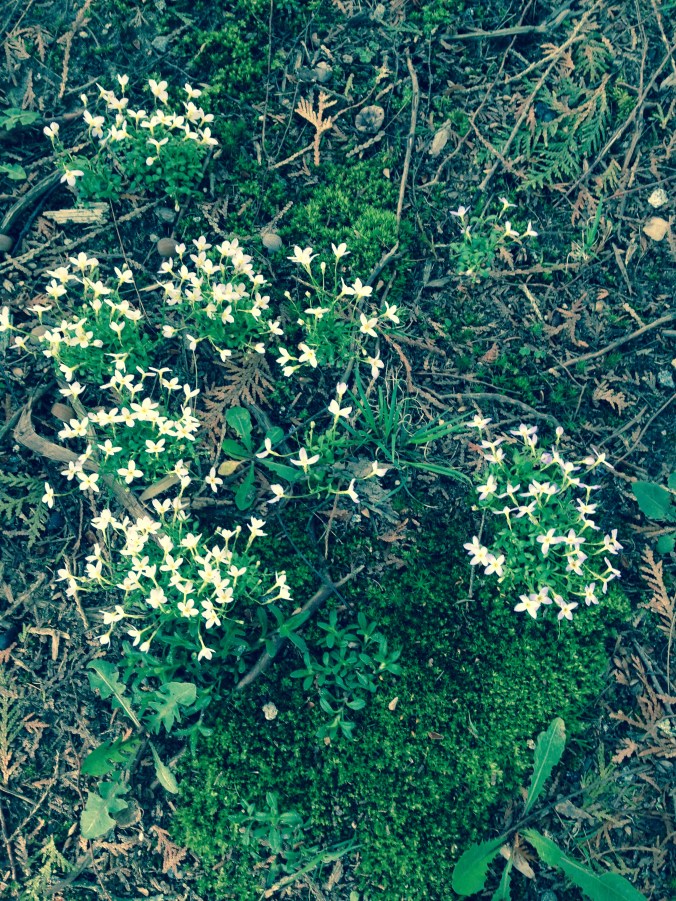
small white flowers

Somewhere along Bridge Street


Found nest

Spotted this nest today along the shore of one of the quarry ponds, near Plattwood Park


Timberdoodle versus Human: Which Singles Scene is More Exhausting?

American Woodcock

American Woodcock image courtesy of Paco Lyptic on Flickr

I don’t miss my single days—trying to look just right, the awkwardness of some conversations, disappointing dates, and being pursued by men who just seemed overeager.

Of course, that was a long time ago. And I don’t know for certain if it’s still the case that the men often take the lead—asking for a phone number, or a date, or trying to plan a “perfect” night. For all I know, the women are in complete control now! But, back in the day, I felt for these guys, with such an onus of needing to impress the girl.

Well, I’m here to argue that the American Woodcock (aka Timberdoodle or Bog Sucker) has a much more difficult time of it. For proof, if you are local, get to the Stewart B. McKinney Wildlife Refuge in Westbrook this Sunday for a repeat of this  past Saturday’s American Woodcock event—a brief talk and then watching the male do his elaborate courtship display.

Scientists or other exacting readers, please forgive me if this summary is less than 100% precise. But the male’s courtship job basically involves:

  • Calling out for quite some time (can you say PEENT?) while rotating in a 360-degree circle on the ground
  • Shooting up into the sky for an erratic (or maybe to the female, it’s erotic) flight while making strange whistling sounds with your feathers
  • Zooming back down while making another sound, described by some as “whimpering chirps” (is this desperation setting in?)
  • Landing in about the same spot, often to do it all over again (and again) (and again).

All of this is based on the assumption that there must be a female woodcock camouflaged in the brush, just waiting to meet you!

Here’s a good account, complete with audio, from Miracle of Nature.

If you can get to the local event, it is so worth it. It’s led by Patricia Laudano, president of the local Potopaug Audubon Society. She’s been developing her very specialized expertise in this species for many years! (If you don’t hail from Connecticut, it might be worth researching if there’s something like this going on in your area.)

It is a truly a treat to learn about these amazing creatures, their upside-down brains, and the labor-intensive ritual that makes human dating look like a cake walk!  Plus, to me they are uniquely enchanting. Bonus: they are an ungainly, endearing, persistent, and often unnoticed sign of spring!


New Year’s Gift: For Nature Lovers and Writing Hopefuls

Last week’s entry was about the gift of a snail (well, a book about one, anyway), and my resulting fervent wish for snail love darts.

This week, I am offering a small gift (although not as small as a snail love dart). I’ve written some basic, beginning instruction on how to get started with nature writing, and a free PDF excerpt from the book is available on the Lessons in Nature Writing tab.  I’d appreciate it greatly if you would share the link!!

Join the Club (Moss)!

One of the best things about being out in nature is the absolutely limitless supply of opportunities to learn. On par with that plus are the many reasons for hope and delight to be found in places as seemingly humble as the forest floor.

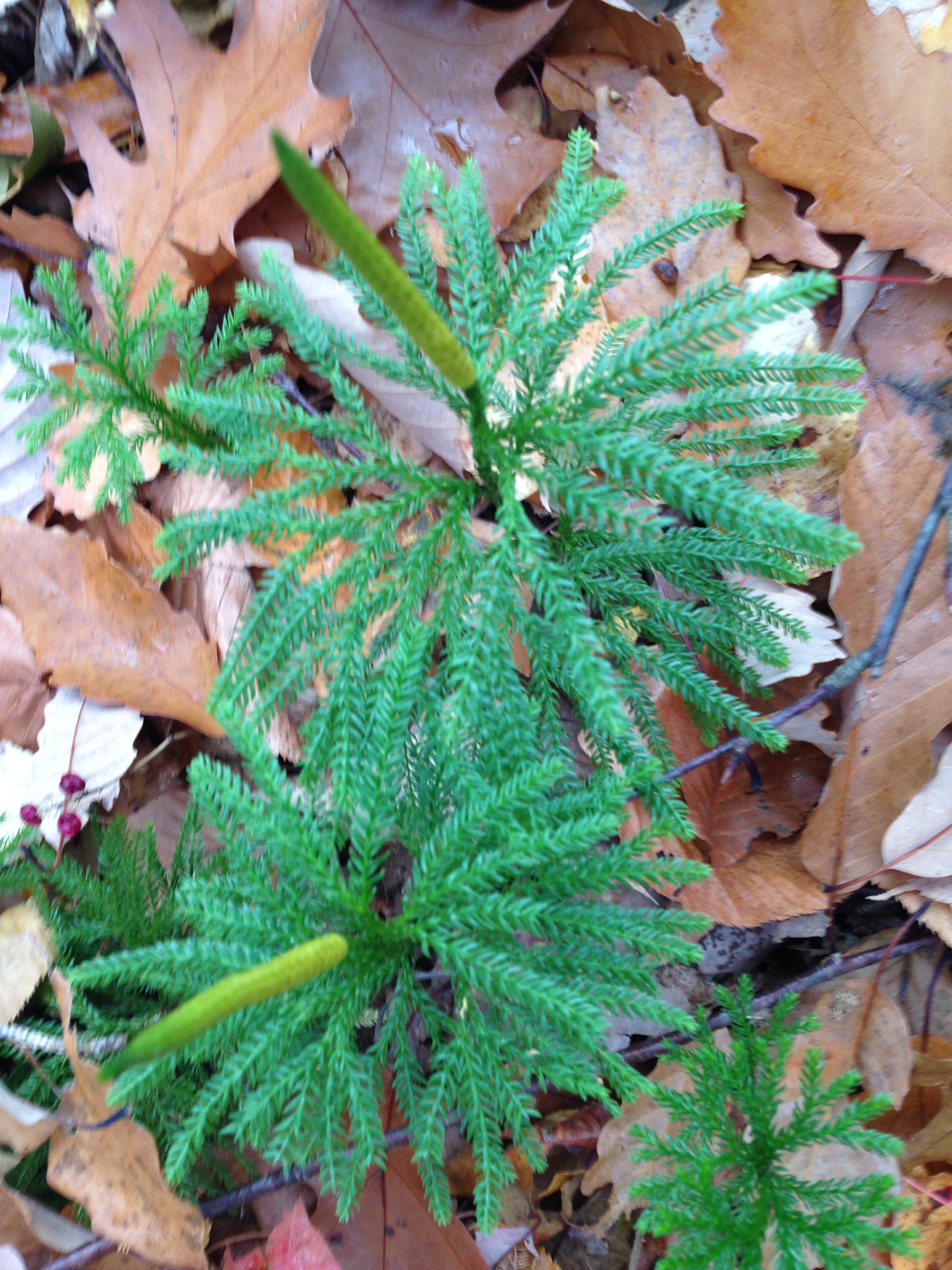
My latest study—and also hopeful venture—is club moss. This link leads to the inaturalist page for Connecticut club moss sightings. I am particularly enamored of running pine moss, which really does look to me like a little figure that’s about to dash off a la the Gingerbread Man of childhood story books (it’s pictured in above link)! But most often, in the Cockaponset State Forest behind our house, I see princess pine:

2015-11-05 07.54.11

According to inaturalist its spores used to be used as flash powder (in early photography or magic tricks ). I know if I tell Gavin he’ll want to try that out pronto, and preferably with bushels of spores. Come to think of it, some adults I know would be right on that, too. (Can’t vouch for how to do this, or for safety. Also, some states list the plant as endangered, likely a result of earlier enthused harvesting.)

This Massachusetts land trust’s site has a nice write-up about the princess pine. What I like best about this diminutive species, which is not a pine at all, is its evergreen-ness. It comforts me when I think ahead to the depths of winter. It is also such a pretty and precise-looking plant.

Before I read The Beginning Naturalist by Gale Lawrence, I’d assumed that the princess pine and other similar club mosses were baby evergreen trees. But they are already fully grown, and they are not in the conifer family. Confusingly, the club mosses are not mosses, either. They are closer to ferns. The “club” refers to the club or spike that shoots right up from the plant—it is coated with a fine layer of spores. The growth from spore to mature plant takes a full 17 years, but some plants can also grow by sprouting along the same stem.

Gale Lawrence’s chapter on these plants amused me, because she refers to the “attacks of the Christmas decorators.” Determined crafters let loose in the woods can pull up whole long underground stems of club mosses for weaving into wreaths, wiping out that impressive life cycle with one good yank. Even without the greenery of Christmas in mind, it is a bit tempting to imagine taking one of these miniature (non) trees home. But the happy-seeming plant has worked too hard to become a pet. Best to visit it in its “home in the loam,” beside its mushroom, acorn, and looming tree neighbors.

BONUS photo for those who read to the end! 😉 : the decorative lichens (or could they be mushrooms??) adorning a stump in our yard! This is just a bit blurry, but I can’t be the only one who thinks these are simply gorgeous.

2015-11-10 07.25.39


A Trove of Seeds

Chestnut Oak acorn, courtesy of U of Kentucky's Department of Agriculture page

Chestnut Oak acorn, courtesy of U of Kentucky’s Department of Agriculture page

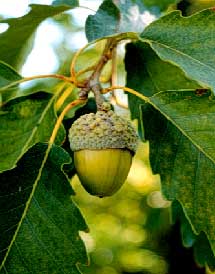
Last week, a coworker gifted me with a jumbo-sized acorn. She’d wanted to work outside for a little while, but had to come in because the oak tree above the picnic table was dropping these plump seeds in an urgent and generous rain. Even walking across the grass had become a challenge, as if navigating a small sea of ball bearings. I hadn’t thought much about it before, but a quick Internet search told me there are quite a few kinds of acorns—I think this one was a chestnut acorn. (Here’s a link to an iconic chestnut oak specimen in Clinton, CT–I hope it’s still there!). Our local oaks seem to be having “mast years,” dropping huge volumes of their offspring after a season of favorable weather and ramped up production.

Seeds buok imageMy acorn research coincided beautifully with my latest read—Seeds by Richard Horan. The author traveled around the country, visiting trees that inspired famous American writers as well as other notables. He scooped up samples of many trees’ progeny, sometimes on a solo journey, sometimes with family or friends. I’d like to ask him what became of the resulting plantings. Is there, somewhere closer to home than Monroeville ( Alabama’s literary capital), a Harper Lee chestnut that I can visit?

Chilly Walk photo from Chris Ford on Flickr

Chilly Walk photo from Chris Ford on Flickr

I liked what one of Horan’s friends said: “You know, when you initially arrive at a site, you think there’s nothing there, but after spending a little time looking around, trees begin to appear.” Of course, our silent observers are always there, often assuming a strictly background role. Many precede us, and many will survive long after we are gone, so I regard them as wise and infinitely patient, owing to their long lives and inability to walk away. I like what Willa Cather (one of the many authors featured in Seeds) had to say about them, too: “I like trees because they seem more resigned to the way they have to live than other things do.” I am not so sure (forgive me, Willa!) that I would have chosen the word “resigned.” Maybe, after all these years the resigning has evolved into accepting. John Muir was more optimistic: “I never saw a discontented tree.”

This season is often thought of as a time of winding down, but time outside reminds me that so many creatures are hurriedly proliferating before the cold and stillness of winter wreaks a time of suspended animation for many. I’ve noticed gypsy moth pupae in the trees around my office park, a bit concerned because I don’t think it’s the right season and I know they can fall prey to all manner of infections. I’m fully aware that these insects are considered pests, but observing them in recent years has made me more sympathetic. I like the moth-like shape of their felted egg masses and wonder how many will survive the winter.

Gypsies and their kids at Trail Wood

This, too, is the time for planting bulbs—something I too often forget to do. I am especially taken with one advertised: The Poet’s Daffodil. I like the haiku-like description on the American Meadows site (line breaks inserted by me!):

Flowers are pure white with
a yellow cup edged in red.
Sweet fragrance

Poet's Daffodil, from Klasse im Garten on Flickr

Poet’s Daffodil, from Klasse im Garten on Flickr

Of what poet was this bulb’s namer thinking? I’ve no idea, but it just so happens I have a Robert Frost anthology beside me. My mom, whose memory and hearing are so very poor now, came alive when we took turns reading from it last Tuesday, this treasured corner of her mind not unlike a bulb that’s overwintered finally flowering. I’ve flipped to this Frost poem today. It reminds me of the inevitability, and often hibernating gifts, of bleaker seasons:


In Hardwood Groves

The same leaves over and over again!
They fall from giving shade above,
To make one texture of faded brown
And fit the earth like a leather glove.

Before the leaves can mount again
To fill the trees with another shade,
They must go down past things coming up.
They must go down into the dark decayed.

They must be pierced by flowers and put
Beneath the feet of dancing flowers.
However it is in some other world
I know that this is the way in ours.

Preserves and Professional Parks

path in woods startMy friend Chris asked me recently about my week-long nature writing residency at the Trail Wood memorial preserve, and the first two words that came to mind were “life-changing.” I reveled in the chance to be in nature alone for extended periods, to contemplate, to write and rewrite, to read the treasured words of Edwin Way Teale in his very home, his very office—a sacred place to me! For the first time ever, I used up the camera storage in my iPhone. This blog isn’t big enough to contain the wealth of images, so I’ve scattered a select few throughout the post.

butterflyfuzzy mushroom lichenOf course, Trail Wood had many creatures and plants that I don’t see every day. The Beaver Pond became my favorite destination, and one morning I watched one of the beavers having an early swim. I took photo upon photo of insects in both meadow and forest, but I wasn’t usually swift enough to capture the many birds digitally. I looked forward to daily sightings of the woodchuck who lived near the house. My suburban New York roots showing, I sang to myself in the woods and carried pepper spray just in case the reported resident bear didn’t like my performance. (Maybe the bear wasn’t as exotic as it seemed. There have been several reported sightings in Deep River neighborhoods recently!)

Teale cabinAn absolute gift of the preserve was its undisturbed quality. But another gift I took away from my time there is the practice of really looking and listening even in places that haven’t had the benefit of such thoughtful stewardship. I  take small walks around the office park where I work, not by any stretch a nature preserve. Still, I smile at the abundance of Carolina locusts behind the buildings (who don’t seem to be doing any noticeable damage), and the occasional spotting of a raptor, bright bird, dragonfly, or hornets. I look down into the wetlands below the tall hill. Once in a while, I see a deer. Just once, I rescued a young raccoon who was clattering around in the nearly empty dumpster, watching from a distance as he climbed the long birch limb escape ladder I’d lowered for him.

Just the other day, I snapped a picture of a delicately decorated moth (looked like the oversized Oriental vases my grandfather had around his house) who turned out to be an ailanthus webworm moth. I love it when nature comes right to my door!

alianthus web worm

While staying at the Teale home I was drawn to a book of Mr Teale’s that I hadn’t read before: Days without Time. The edition on the study shelf was dated 1948, just 3 years after his son David was killed in World War II. Teale’s introductory words ring so very true:

The fall of the tree, the swoop of the hawk, the tilt of the buzzard in a windy sky, the song of the hermit thrush at evening, the opening of a windflower, the eddy of a woodland brook—all of these are events for days without time. They might have occurred during any one of a thousand or ten thousand years. Ticking clocks and factory whistles have little to do with the eternal recurrence of these eternal themes.

Something for me to remember after my New Hampshire vacation, chock full of walks in shallow streams and visits to waterfalls: when the “factory whistle” is again in play, nature doesn’t live only in preserves or the areas we think of as great sightseeing locales. It is everywhere. With eyes and ears wide open, every day is a new chance to notice it, to give it the full attention that it deserves. With that attending we find ourselves more connected and more alive.